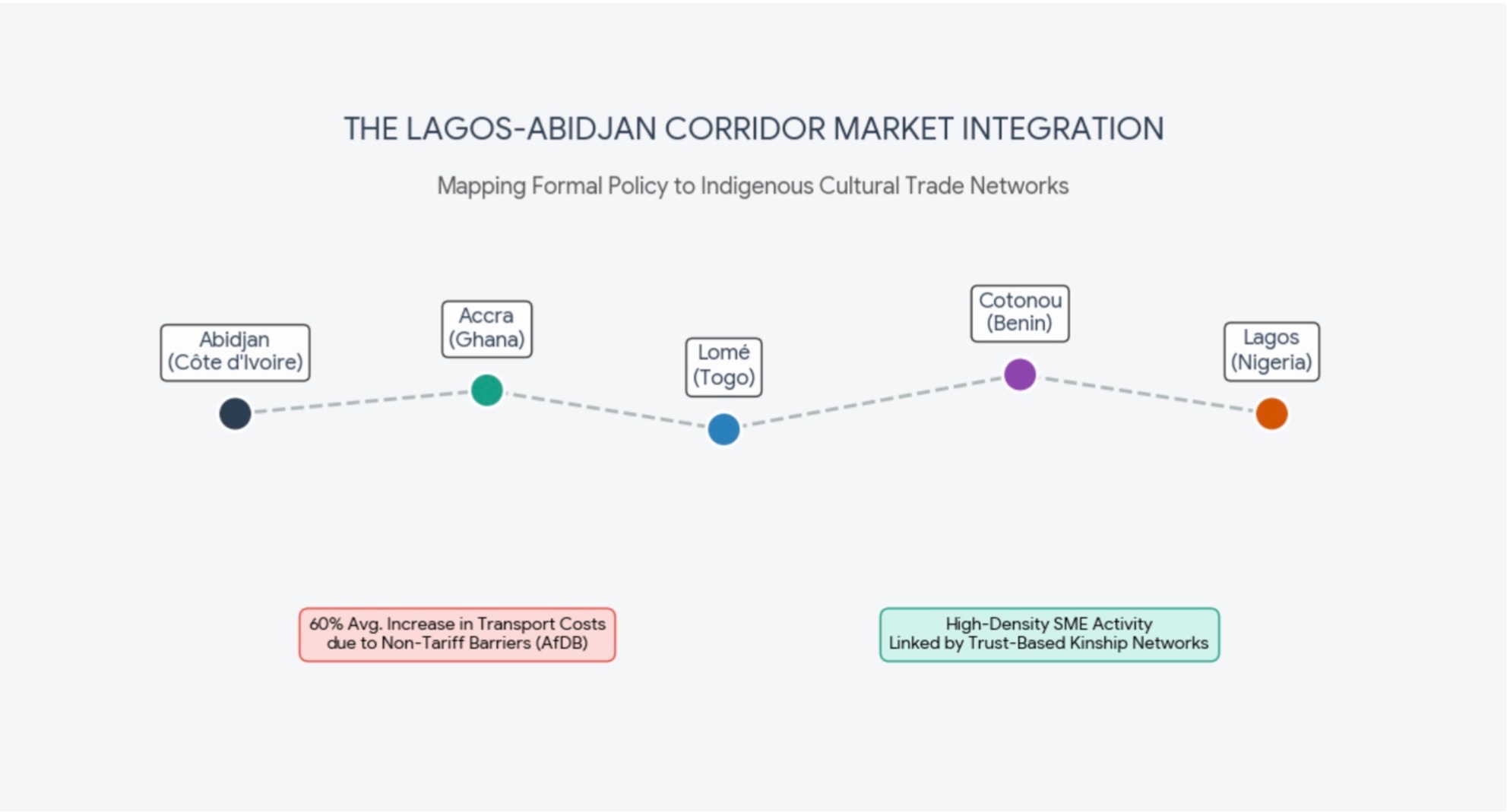
Before the loudspeakers come to life , Amara is already at work. By 5 am she has loaded the 20 kilograms sacks of okra , carefully wrapped and tied down on a motorcycle headed for the Seme border. The pre-dawn air along the Lagos–Badagry Expressway smells of diesel and wet laterite. She has made this journey forty-one times this year. She knows, with the precision of someone who has paid for the knowledge, exactly where each checkpoint will slow her: the one near Mile 2 where the officer in the yellow vest always wants a “clearance fee,” the cluster of three near Badagry where the queue can swallow an entire morning. She does not know what the African Continental Free Trade Area is. She has heard the word, the way you hear a sound from another room available , but not understandable. What she knows is the mathematics of friction: how much it costs, in naira and hours, to move twenty kilograms of okra from Lagos to Cotonou and return with cotton prints. That mathematics is the real AfCFTA. Everything else is a press release.
The Architecture of Promise
Five years since trading formally commenced under the African Continental Free Trade Area, the ledger of institutional achievement is not trivial. Fifty-four countries have signed the agreement. Fifty state parties have ratified it. The market it encompasses $3.4 trillion in combined GDP is continental in scope and consequential in theory. According to Afreximbank’s Africa Trade Report 2024, intra-African trade reached $192.2 billion in 2023, a 3.2 per cent year-on-year increase, with the formal trade share rising from 13.6 to 14.9 per cent. A five-year review by ITUC-Africa and the Africa Labour Research and Education Institute found that AfCFTA’s implementation generated 2.3 million net new formal and informal jobs between 2021 and 2024 across twenty-five African countries.
The Guided Trade Initiative AfCFTA’s pilot mechanism, designed to test actual trade flows before full liberalisation enrolled eight countries, 96 product categories, and produced the continent’s first documented cross-border AfCFTA shipments: Rwanda’s instant coffee, Kenya’s batteries, Cameroon’s safou and dried pineapple. These were not symbolic. They were proofs of concept, demonstrating that the plumbing could hold water.
The framework seems powerful and well structured, the question is who gets to live inside it.
- $192.2bn Intra-African trade, 2023 (Afreximbank)
- 2.3 million Net new jobs, 2021–2024 (ITUC-Africa, 2025)
- 50 AfCFTA state parties ratified
Ghana’s Forty-three
Ghana entered the Guided Trade Initiative as one of its original seven pilot nations, alongside Rwanda, Cameroon, Egypt, Kenya, Mauritius, and Tanzania. Its National AfCFTA Coordinating Office issued 43 certificates of origin to micro, small, and medium enterprises for GTI-designated exports a number that was reported as progress, and is progress, in the way that a single footprint in concrete is progress toward a road.
A September 2024 review by the Overseas Development Institute examined the AfCFTA registration and rules of origin certification process in Ghana with methodological care. Its findings were not ambiguous. The certification process is centralized and costly: an MSME in Kumasi or Tamale must frequently travel to Accra to complete registration – a design flaw, not an implementation failure, that systematically excludes women-owned businesses and smallholder producers who cannot absorb the time or transport costs. The ODI report further found that the goods Ghana has exported under AfCFTA are, in most cases, in primary form. Raw cassava. Unprocessed shea butter. The continent’s most celebrated free trade agreement is, for Ghana’s smallholders, a mechanism for exporting their least valuable output.
This is not a peripheral problem. The distance between raw cassava and processed cassava starch is the distance between subsistence and income. A 2024 academic study of 250 Ghanaian SMEs found a significant gap in readiness: limited knowledge of export documentation, trade finance structures, and AfCFTA protocols themselves. These firms did not fail, they were never equipped to succeed. The 43 certificates are real. What they represent a formal economy still largely inaccessible to the people it was built to serve is also real.
The ODI found that goods exported under AfCFTA are, in most cases, in primary form raw cassava, unprocessed shea butter. The continent’s most celebrated free trade agreement is, for Ghana’s smallholders, a mechanism for exporting their least valuable output.
Nigeria’s Celebrated Shipmen and It’s Shadow
Nigeria’s entry into AfCFTA’s Guided Trade Initiative arrived with ceremony. The country’s first GTI shipment, executed under President Bola Tinubu’s administration, was received as a continental milestone evidence that Africa’s most populous economy and largest GDP had finally moved from spectator to participant. It was a moment worth marking.
Nigeria’s AfCFTA Consolidated Implementation Report 2024–2025, released in March 2026 after the passing of the agreement’s National Coordinator, Olusegun Awolowo, whose death the report notes with quiet dignity describes this transition as moving from “preparatory groundwork to execution.” The phrase is honest in what it admits: years of preparation are only now beginning to translate into operational trade. The report confirms that Nigeria has submitted draft service offers in five priority sectors business services, communication, financial, transport, and tourism but these remain under stakeholder validation, not yet in effect.
Meanwhile, a survey cited by Brookings and the Nigerian Association of Chambers of Commerce, Industry, Mines and Agriculture (NACCIMA) found that only 25 per cent of Nigerian MSMEs were even aware of AfCFTA’s existence. Not unprepared, unaware. The continent’s $100 billion trade finance gap, documented in the same implementation report, continues to wall off the majority of small businesses from formal cross-border commerce. For most informal traders moving goods through Seme, Idiroko, or Jibia, AfCFTA is not a policy they oppose or support. It is a rumour they have not yet heard.
25% Nigerian MSMEs aware of AfCFTA (Brookings/NACCIMA)
$100bn Persistent trade finance gap across Africa
The Road is the Policy
Set aside what the leaders officially said at the summit, drive the Seme–Badagry corridor and the policy text becomes asphalt, and the asphalt tells a different story.
The ECOWAS Commission’s own principal trade advisor, presenting before a Nigerian Shippers’ Council meeting in 2023, documented 57 checkpoints between Mile 2 and Badagry a stretch of road that, on a clear morning with no traffic, takes under two hours to drive. In practice, it can take a full day. The Nigerian Customs Service Area Controller for Seme Border Command described the proliferation of illegal checkpoints as “disgraceful” and “a major obstacle to trade facilitation” at a formal stakeholders’ meeting in October 2025. The institution responsible for enforcing trade at the border was condemning the conditions at the border. This is the distance between policy and practice rendered in official language.
What happened next is the most instructive data point in this entire story. Following a high-level stakeholders’ meeting in January 2025, the Seme corridor was formally reduced to two official checkpoints by December 2025. And revenue the government’s own revenue at Seme Customs Command jumped 117 per cent year-on-year, from 7.2 billion in 2024 to 15.6 billion in 2025. Less informal extraction produced more legitimate revenue. The checkpoints were not protecting trade. They were taxing it illicitly, skimming from the informal economy and starving the formal one.
But the woman who paid fifty informal levies before December 2025 did not receive a refund. Amara’s forty-one journeys this year each carried a toll that no policy reform erases retroactively. The cost was absorbed, as it always is by the people with the least capacity to absorb it.
The checkpoints were not protecting trade. They were taxing it illicitly skimming from the informal economy and starving the formal one. When they were reduced, revenue jumped 117 per cent.
PAPSS and the Invisible Majority
The Pan-African Payment and Settlement System [ PAPSS] is Afreximbank’s answer to one of the most persistent structural barriers in intra-African trade: the requirement that transactions be invoiced in US dollars, routed through correspondent banks in New York or London, and settled with fees that can consume ten to fifteen per cent of a transaction’s value. PAPSS promises near-instant local-currency transfers between African countries, bypassing USD intermediation entirely. It is designed to bring about major changes.
Its implementation record is more complicated. As of late 2025, ten African central banks are enrolled. The Central Bank of Egypt joined in November 2024. The Central Bank of Nigeria streamlined its PAPSS documentation requirements in May 2025 a concrete step toward adoption. The technical architecture works. tralac, the Trade Law Centre, confirmed in 2025 that the system is operational and expanding.
The problem is built into the system. A February 2025 analysis by the Mobile Ecosystem Forum found that PAPSS adoption remains gradual; that SMEs, particularly, lack awareness of it; and that commercial banks require technology upgrades before they can onboard. More fundamentally: PAPSS operates in the formal banking sector. Estimates from the Cameroon Economic Policy Institute put the share of intra-African trade invoiced in USD and therefore moving through formal channels at over 80 per cent of documented trade. But an estimated 80 per cent of all intra-African trade is informal and undocumented. PAPSS for now, is a solution for the people who least need it registered businesses with bank accounts and an abstraction for the cross-border trader who carries cash folded in a wrapper inside her brassiere because no bank on the corridor has ever offered her an account worth keeping.
- 80% Intra-African trade that is informal and undocumented
- 10 African central banks enrolled in PAPSS (late 2025)
When Entrepreneurs Build the Tools the System Failed to Provide
In May 2025, sixty teams more than 200 young innovators drawn from Nigeria, Ghana, The Gambia, Malawi, Niger, and Algeria gathered in Lagos for the inaugural AfCFTA Digital Trade Hackathon. They were not there to celebrate the agreement they were there to repair it.
The Grand Prize of 20 million went to ExportPlug, a platform that connects African producers to continental markets using smart matching algorithms and real-time competitive pricing data the kind of market intelligence tool that should have been part of AfCFTA’s original MSME support architecture. The second runner-up, GET AI, is building a regulatory sandbox for automated cross-border transaction compliance software that attempts to solve, programmatically, the bureaucratic opacity that has kept MSMEs out of formal AfCFTA trade since the agreement launched.
These are not passion projects. They are damage control. The fact that young innovators had to build these tools in a 48-hour competition rather than receiving them as part of AfCFTA’s operational infrastructure is the clearest indictment of the implementation gap this article has spent 1,400 words documenting.
Olusegun Awolowo, Nigeria’s AfCFTA National Coordinator before his passing, said of the hackathon: “The AfCFTA Hackathon is a groundbreaking leap for Africa. It proves youth innovation is the driving force of a prosperous African trade ecosystem.” He was right. It also proves something he would not have said: that when institutions fail to build the tools entrepreneurs need, entrepreneurs build them anyway and someone should ask, loudly, why it came to that.
All sixty teams have been inducted as Founding Members of the Nigeria AfCFTA Startup Academy, with access to funding channels and programmatic support. It is, at minimum, an acknowledgment that the gap is real and the young people filling it deserve resources.
CODA: What it Costs
Return to Amara, She is already on her way back by the time the first official AfCFTA press release of the day is drafted in Accra or Abuja or Addis Ababa. She does not know about the 117 per cent revenue jump at Seme. She does not know that the GTI has been quietly phased out and replaced with broader operational trade. She knows that this week’s checkpoint cost her 4,700 she did not budget for, and that the cotton prints she is bringing back will have to sell fast because the school fees are due at the end of the month.
The numbers are real $192 billion in intra-African trade, 2.3 million new jobs, 54 signatory nations. But every number represents 20 per cent of the actual economy. Eighty per cent moves unseen, uncounted, and largely unsupported, carried on heads and in boots and in cloth wrappers across borders that are still, five years into the most ambitious trade agreement in African history, full of men with outstretched hands.
What does it cost, in years and naira and cedis and dreams deferred, to trade in Africa while Africa is still becoming what it has promised to be? That question has no entry in the trade data. It lives in the forty-one journeys, in the stiff lower back at 5 a.m., in the mental arithmetic performed at every checkpoint to determine whether today’s levy is worth arguing about or simply easier to pay.
AfCFTA’s promise is not false. Its architecture is not fraudulent. But a promise is only as real as its delivery and right now, delivery is unevenly distributed in ways that track, with uncomfortable precision, the same inequalities the agreement was designed to dissolve.
Sources
Primary Institutional Sources
- Nigeria AfCFTA Consolidated Implementation Report 2024–2025. Nigeria AfCFTA Coordination Office, March 2026. https://afcfta.ng/AfCFTA-2024-2025-Implementation-Report.pdf
- ODI Research Report: Review of the AfCFTA Registration and Rules of Origin Certification Process: A Case Study of Ghana. Overseas Development Institute, September 2024. https://odi.org/en/publications/review-of-the-afcfta-registration-and-rules-of-origin-certification-process-a-case-study-of-ghana/
- AfCFTA Secretariat Official Site. https://au-afcfta.org
- PAPSS Official Documentation. https://papss.com
- Nigeria AfCFTA Hackathon Results (May 2025). Punch Nigeria. https://punchng.com/nigeria-records-progress-in-afcfta-implementation-report/
Trade Data and Economic Analysis
- Afreximbank Africa Trade Report 2024 — cited in: Brookings Institution. Intra-African Trade and Its Potential to Accelerate Progress Toward the SDGs. https://www.brookings.edu/articles/intra-african-trade-and-its-potential-to-accelerate-progress-toward-the-sdgs/
- Africa Labour Research & Education Institute / ITUC-Africa. A Five-Year Review of the AfCFTA Through a Trade Union Lens, 2025. https://tradeunionsinafcfta.org/a-five-year-review-of-the-afcfta-through-a-trade-union-lens/
- Brookings/NACCIMA Survey — cited in: Finance in Africa. Nigeria’s First AfCFTA Review. https://financeinafrica.com/insights/nigerias-first-afcfta-review/
- AfCFTA 2024–2025 Implementation Report summary. IT-RC. https://it-rc.org/2026/03/05/african-continental-free-trade-area-2024-2025-implementation-report/
Border and Infrastructure Evidence
- ECOWAS Commission / Nigerian Shippers’ Council Meeting (2023). 57 Checkpoints Along Badagry-Seme Expressway Frustrating Intra-African Trade. Leadership Nigeria. https://leadership.ng/57-checkpoints-along-badagry-seme-expressway-frustrating-intra-african-trade-ecowas/
- Nigeria Customs Service / The Guardian Nigeria, October 2025. Customs, NDLEA Others Vow to Tackle Illegal Checkpoints Along Seme Border. https://guardian.ng/news/customs-ndlea-others-vow-to-tackle-illegal-checkpoints-along-seme-border/
- Seme Customs Command Revenue Report (January 2026). Seme Customs Command Generates N15.5bn in 2025. This Page Newspaper. https://thispagenewspaper.org.ng/2026/01/07/seme-customs-command-turns-things-around-generates-n15-5-billion-revenue-in-2025-against-n7-1-billion-in-2024/
- TVC News, January 2025. Stakeholders Agree on Four Checkpoints Along Seme Border Corridor. https://www.tvcnews.tv/2025/01/stakeholders-agree-on-four-checkpoints-along-seme-border-corridor/
- UNECA/Afreximbank Seme-Krake Study. https://archive.uneca.org/stories/trip-seme-krake-mending-cracks-benin-nigeria-trade-relationship
Payment Systems
- tralac (Trade Law Centre). PAPSS Analysis 2025. https://www.tralac.org/documents/events/tralac/5864-2025-conference-two-pager-papss/file.html
- Mobile Ecosystem Forum, February 2025. Pan-African Payment and Settlement System (PAPSS): The Revolution of Cross-Border Payments in Africa. https://mobileecosystemforum.com/2025/02/19/pan-african-payment-and-settlement-system-papss-the-revolution-of-cross-border-payments-in-africa/
- AllAfrica / CBN PAPSS Circular, May 2025. https://allafrica.com/stories/202505120372.html
- Cameroon Economic Policy Institute. Economic Implications of PAPSS on Intra-African Trade, December 2025. https://camepi.org/2025/12/13/economic-implications-of-the-pan-african-payment-and-settlement-system-papss-on-intra-african-trade/
Hackathon and Youth Innovation
- Premium Times, May 2025. ExportPlug Claims N20 Million Grand Prize at AfCFTA Hackathon. https://www.premiumtimesng.com/business/business-news/793346-exportplug-claims-%E2%82%A620-million-grand-prize-at-afcfta-hackathon-paving-way-for-intra-african-trade-innovation.html
- Shipping Position / Rededit Magazine, May 2025. ExportPlug Wins N20m Grand Prize at AfCFTA Digital Trade Hackathon Grand Finale. https://shippingposition.com.ng/exportplug-wins-n20m-grand-prize-at-afcfta-digital-trade-hackathon-grand-finale/
- MeaTech Watch, May 2025. Inaugural AfCFTA Hackathon 2025 Kicks Off in Lagos. https://meatechwatch.com/2025/05/02/inaugural-afcfta-hackathon-2025-kicks-off-in-lagos-with-n20-million-grand-prize/