
Productive Credit
Over the past decade, Ghana has undergone significant transformations in financial inclusion, digital payments, and financial-sector development. These changes have strengthened the country’s business environment by improving access to formal financial services, increasing transaction efficiency, and supporting private-sector activity. Despite this progress, access to productive credit remains a key constraint for many businesses, particularly micro, small, and medium-sized enterprises (MSMEs). This article evaluates Ghana’s current business environment and argues that expanding access to productive credit represents one of the most important challenges for the country’s next phase of economic development.
Macroeconomic Recovery
Three years after a debt crisis pushed Ghana’s debt-to-GDP ratio above 90 percent and drove inflation into double digits, the country has made a remarkable economic recovery. Real GDP growth reached 5.8 percent in 2024 and accelerated to 6.0 percent in 2025, while inflation fell to 3.3 percent in February 2026. International reserves also strengthened, reaching the equivalent of 5.8 months of import cover, and fiscal consolidation efforts produced a primary surplus of 2.6 percent in 2025, exceeding the government’s target of 1.5 percent.
For entrepreneurs and investors, these improvements are more than macroeconomic achievements. Greater price stability, stronger public finances, and improved foreign exchange reserves have helped create a more predictable business environment, reducing some of the uncertainties that previously constrained business planning and investment decisions. As a result, startups and small businesses may find it easier to assess market opportunities and pursue long-term growth strategies.
Investor confidence appears to be recovering as well. In fiscal year 2026, the International Finance Corporation financed and mobilized approximately USD 505 million in private-sector investment in Ghana, up from USD 410 million the previous year. This increase in private investment suggests growing confidence in Ghana’s economic outlook and highlights the country’s potential as an emerging destination for entrepreneurial activity and business expansion in West Africa.
Institutional Foundations of the Business Environment
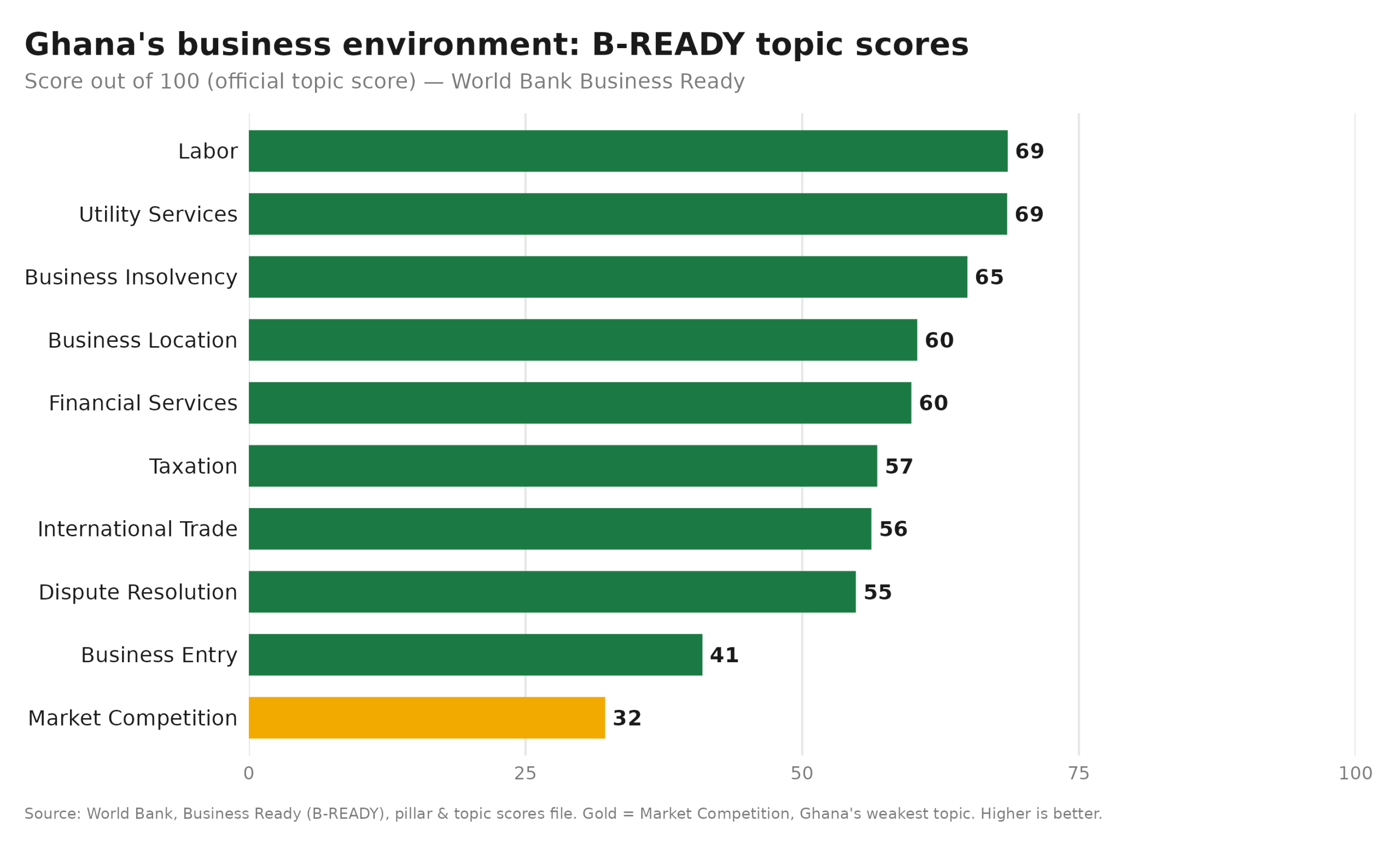
The World Bank’s Business Ready (B-READY) 2024 profile confirms that Ghana has built solid institutional foundations. The country scores highest in labor regulation, public utility services—electricity, water, and internet—and business insolvency, all in the 65–69 range out of 100, and its regulatory framework for financial services is among the most developed, near 75 (World Bank, Business Ready) (fig. 1). In practice this translates into concrete good practices: mechanisms to resolve labor disputes, transparent information on utility tariffs and connections, and electronic case-management systems for insolvency. These factors contribute to a more predictable environment for business operations and investment decisions.
Figure 1. Ghana’s business environment: B-READY topic scores (0–100). Clear strengths in labor, utility services, and insolvency. Source: World Bank, Business Ready.
Financial Inclusion and Digital Access
The most visible transformation is access. According to the Global Findex 2025, 81% of adults have an account, 78% have a mobile-money account, and 79% made or received a digital payment (Demirgüç-Kunt et al.) (fig. 2). Ghana is also the only African economy whose domestic retail payment schemes are fully interoperable with one another, a distinction highlighted in AfricaNenda’s State of Inclusive Instant Payment Systems assessment (AfricaNenda et al.), and the value of mobile-money transactions reached about two and a half times annual GDP in 2024 (Bank of Ghana, Payment Systems). Account ownership—the first-generation marker of inclusion—is, in practice, achieved.
Figure 2. Digital connectivity and economic activity in Ghana (% of adults, 15+). Source: Global Findex 2025, World Bank.

The impact on the MSME economy is direct. Micro, small, and medium-sized enterprises make up roughly 92% of registered firms, nearly 80% of employment, and about 70% of GDP (Ghana Statistical Service); for them, the ability to collect, pay, and formalize operations digitally with this ease was unthinkable a decade ago (fig. 3). The widespread adoption of digital payment systems has become an important component of Ghana’s business ecosystem.
Figure 3. Financial inclusion in Ghana: account and digital-payment access versus formal credit (% of adults, 15+). Source: Global Findex 2025, World Bank.

This progress has also been a powerful equalizer for women. Mobile money in particular has narrowed a gap that long held them back: Ghana is among the countries that have halved their account-ownership gender gap since 2021, as women adopted mobile-money accounts in large numbers (CGAP). For women-led businesses—a large share of Ghana’s MSMEs—this means more of them can receive payments, build a transaction record, and operate formally. Here, too, the unfinished work is credit: women entrepreneurs have historically faced the widest gap in access to formal finance, so turning their growing digital footprint into productive credit is exactly where the next phase of inclusion will be decided. The expansion of digital financial services may also facilitate greater access to formal credit among women entrepreneurs.
Private-Sector Innovation in Digital Credit
Ghana’s private sector is already turning this infrastructure into value. Fintechs—financial-technology companies—show what is possible: Qwikloan, a mobile credit product from Letshego (with MTN and JUMO), passed its millionth customer within a year of launch and keeps growing; and JUMO, a digital-credit fintech, reports around 9.6 million customers in Ghana and over 128 million loans disbursed (JUMO). These examples suggest that digital transaction histories can complement traditional lending mechanisms and support new forms of credit assessment.
Remaining Challenges and the Policy Agenda
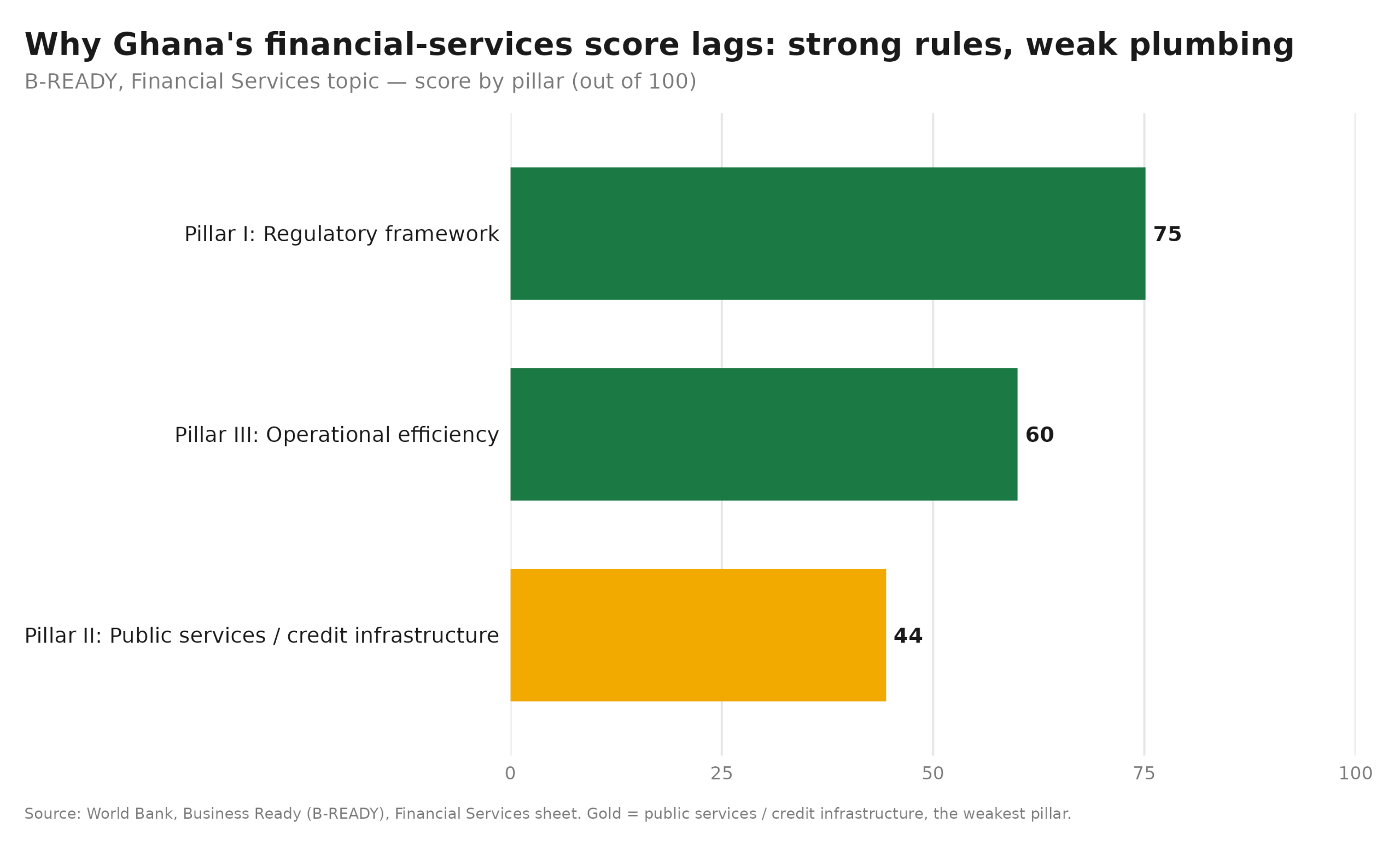
Acknowledging what remains is part of seizing the opportunity. Account access has gone mainstream, but formal credit has not yet kept pace: according to the Global Findex 2025, only about 29% of adults borrowed from a formal institution (Demirgüç-Kunt et al.), and access to affordable finance is repeatedly identified as the top constraint firms face in Ghana (International Finance Corporation and World Bank). B-READY pinpoints where to focus: market competition is the area with the most room to improve (32 out of 100), and credit-information infrastructure—the public-services pillar within financial services—sits around 44, below rules that already approach 75 (World Bank, Business Ready) (fig. 4). Dispute resolution remains one of Ghana’s weakest areas, which adds to the cost of lending without collateral.
Figure 4. Financial services in B-READY: strong rules (Pillar I ≈ 75) but public services and credit infrastructure to strengthen (Pillar II ≈ 44). Source: World Bank, Business Ready.
Several policy options could support further improvements in access to productive credit. Deepening credit-information systems—and allowing a merchant’s mobile-money history to be portable, owned by the user and shareable with consent under open-finance frameworks—would turn that transactional trail into a scoreable credit file. Strengthening competition among lenders would create pressure to innovate, and speeding up dispute resolution would lower the cost of lending. Ghana is already moving in this direction: in 2025 the Bank of Ghana issued a Directive for Digital Credit Services Providers that formalizes licensing and requires lenders to share repayment data with credit bureaus, with customer consent (Bank of Ghana, Directive), while the Ghana Card supports simplified KYC. The country also has regional reference points—M-Pesa in Kenya, the Unified Payments Interface in India, and Vietnam’s national financial-inclusion strategy—that traveled the same road on regulatory sandboxes and interoperability (Zubairu et al.).
Outlook
Overall, the evidence suggests that Ghana has made substantial progress in improving its business ecosystem. In little more than a decade, Ghana moved from fragmented financial access to a first-rate digital economy, with a stable commercial environment, solid rules, and a private sector already innovating on that base. While expanding productive credit remains challenging, Ghana already possesses much of the financial infrastructure required to support further progress. Ten years after the divide between formal and informal finance in Ghana was first mapped, the country has not merely narrowed it: it has built the platform to close it. The institutional capacity is there; the agenda—competition, credit information, and enforceability—is achievable, and the direction is upward.
Works Cited
AfricaNenda, World Bank, and UN Economic Commission for Africa. State of Inclusive Instant Payment Systems in Africa 2024. AfricaNenda, 2024.
Bank of Ghana. Directive for Digital Credit Services Providers, 2025. Bank of Ghana, 2025, www.bog.gov.gh/notice/publication-of-directive-for-digital-credit-services-providers-and-licensing-requirements/.
—. Monetary Policy Committee Press Release, March 2026. Bank of Ghana, 2026, www.bog.gov.gh/wp-content/uploads/2026/03/MPC-Press-Release-March-2026-1-2.pdf.
—. Monetary Policy Report, January 2026. Bank of Ghana, 2026, www.bog.gov.gh/wp-content/uploads/2026/02/Monetary-Policy-Report-January-2026-1-2.pdf.
—. Payment Systems Oversight Annual Report 2024. Bank of Ghana, 2025.
CGAP. “From Access to Agency: The Next Chapter in Women’s Financial Inclusion.” CGAP, 2025, www.cgap.org/blog/access-to-agency-next-chapter-in-womens-financial-inclusion.
Demirgüç-Kunt, Asli, et al. The Global Findex Database 2025. World Bank, 2025.
Ghana Statistical Service. “Consumer Price Index, February 2026.” Ghana Statistical Service, 2026, www.statsghana.gov.gh/.
—. “Gross Domestic Product: Annual Estimates 2024–2025.” Ghana Statistical Service, 2026, www.statsghana.gov.gh/.
—. Integrated Business Establishment Survey (IBES) II. Ghana Statistical Service, 2024.
International Finance Corporation, and World Bank. Creating Markets in Ghana: Country Private Sector Diagnostic. World Bank Group, 2017.
JUMO. “Financial Inclusion in Africa: Ghana Is Leading.” JUMO, 2025, jumo.world/financial-inclusion-ghana-fintech/.
World Bank. Business Ready 2024: Economy Profile of Ghana. World Bank, 2024.
—. “Ghana.” The World Bank Group, 2026, www.worldbank.org/en/country/ghana/overview. Accessed 15 June 2026.
Zubairu, Ibrahim, et al. “Examining the Role of Financial Technology (FinTech) in Financial Inclusion in Ghana: An Evaluation of the Strategies, Impacts, and Challenges in Practice.” International Journal of Economics, Finance and Management Sciences, vol. 13, no. 1, 2025, pp. 1–19, https://doi.org/10.11648/j.ijefm.20251301.11.