
Abstract
Small and Medium Enterprises (SMEs) represent the backbone of West Africa’s economic architecture, yet cross-border expansion remains fraught with operational bottlenecks. While macro-level initiatives like the African Continental Free Trade Area (AfCFTA) aim to eliminate tariffs, SMEs routinely fail due to a lack of alignment with informal cultural trade networks, volatile local regulatory shifts, and non-tariff barriers. This article analyzes the intersection of formalized trade policy and indigenous commercial wisdom along the high-density Lagos-Abidjan corridor. By evaluating the structural impediments faced by cross-border merchants and analyzing how successful enterprises adapt to localized market protocols, this paper provides actionable, replicable strategies for sustainable entrepreneurship. Ultimately, it demonstrates that true regional integration requires combining institutional frameworks with grassroots cultural fluency, transforming cross-border trade from a high-risk venture into a scalable engine of cooperative economic growth.
Background: The Reality of the Cross-Border Commercial Environment
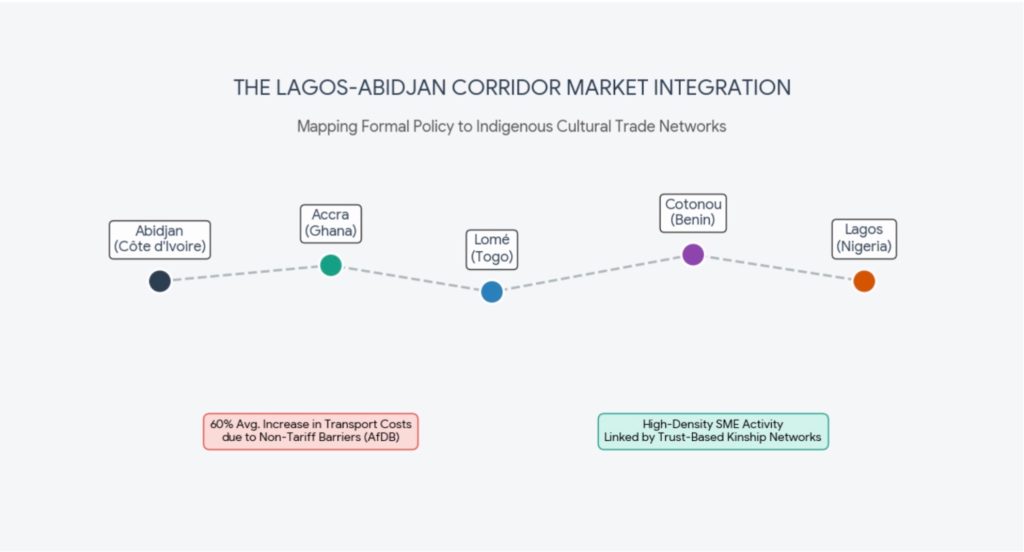
The West African commercial landscape is defined by a striking paradox: deep grassroots cultural integration coupled with intense institutional fragmentation. Along the high-density Lagos-Abidjan corridor—which spans Nigeria, Benin, Togo, Ghana, and Côte d’Ivoire—ethnic, linguistic, and kinship ties historically predate modern national borders. For instance, the Yoruba, Hausa, and Akan trading networks operate seamlessly across Anglophone and Francophone divides, utilizing traditional systems of trust, community accountability, and informal credit that bypass conventional, slow-moving banking systems. These cultural ecosystems show that West African markets are already deeply integrated at a human level, long before formal regional treaties are drafted.
However, when an SME attempts to formalize cross-border operations, it confronts a patchwork of conflicting regional realities that severely disrupt efficiency. First, the Anglophone-Francophone divide forces businesses to navigate completely different legal systems—ranging from British-derived common law frameworks in Nigeria and Ghana to the French-influenced OHADA (Organisation pour l’Harmonisation en Afrique du Droit des Affaires) unified business laws in Benin, Togo, and Côte d’Ivoire. Second, physical infrastructure deficits create massive unpredictability. Transporting goods via roads involves arbitrary border checkpoints, variable customs assessment protocols, and ports prone to heavy congestion, adding substantial hidden transaction costs.
Finally, cultural nuances and deep-seated social taboos dictate market success. Marketing and operational strategies must respect deeply entrenched regional habits. In Ghana, corporate negotiations heavily value formal hierarchy, institutional respect, and indirect communication, whereas in Nigeria’s fast-paced commercial centers, speed, assertiveness, and immediate proof of value are paramount. Overlooking these subtle behavioral patterns frequently leads to broken business partnerships and stranded capital. Therefore, understanding the localized business environment means looking past the text of trade agreements and mastering the social codes that dictate day-to-day interactions.
Structural Challenges Facing Cross-Border SMEs
Despite the Economic Community of West African States (ECOWAS) Trade Liberalization Scheme (ETLS) and the highly publicized rollout of the AfCFTA, regional empirical data indicates that non-tariff barriers (NTBs) increase transport costs by an average of 60% across West African corridors (African Development Bank). These barriers do not appear as overt tariffs but manifest as arbitrary border closures, complex currency convertibility costs between the Nigerian Naira and the West African CFA Franc, and extensive bureaucratic delays at border posts like Seme (Nigeria/Benin) and Aflao (Ghana/Togo).
To gain clear visibility into how these systemic frictions impact small businesses, direct field insights were gathered from two regional entrepreneurs actively navigating the corridor. To safeguard their commercial operations, competitive standing, and supply chains, the interviewees’ real identities have been completely anonymized using secure pseudonyms, and specific corporate identifiers have been generalized to regional classifications.
“On paper, the AfCFTA certificate of origin should grant my processed shea butter duty-free entry into Togo and Benin. In practice, border officials regularly cite localized directives or administrative backlogs to delay my trucks. If you do not have a local customs clearing agent who understands the informal language and social dynamics of that specific border post, your perishable goods will rot in the sun. The formal law matters less than the local officer’s mood.”
— ‘Kofi,’ Mid-sized Agricultural Processor (Accra, Ghana)
“We tried expanding our supply chain into Abidjan, Côte d’Ivoire. We calculated the transport costs based on official freight rates, but completely missed the impact of currency conversion fees and the informal fees charged by local transport unions (Syndicats). Navigating the transport syndicates requires a totally different set of social skills and cultural fluency than negotiating with a formal shipping line.”
— ‘Mariam,’ Regional Cosmetics and Textile Brand Founder (Lagos, Nigeria)
Case Analysis: Cultural Adaptation versus Rigid Operational Models
To understand what separates sustainable cross-border expansion from sudden market failure, it is useful to contrast two distinct strategic approaches within the West African market. Businesses that treat West Africa as a uniform, tech-first canvas often collapse under the weight of local complexities, whereas those that adapt to existing social infrastructure achieve long-term resilience.
Metric / Strategy | Company A: Rigid Standardized Model | Company B: Culturally Adapted Framework |
Market Entry Approach | Replicated home-market strategies exactly in new territories without local calibration. | Partnered with local trade associations and respected traditional market leaders. |
Operational Result | Terminal logistics delays, high storage fees at borders, and market exit within 18 months. | 35% reduction in transit times, optimized customs clearance, and sustainable regional scaling. |
The Standardized Failure
A prominent Nigerian digital B2B logistics startup attempted to expand its door-to-door delivery service into Cotonou, Benin. Operating on a highly standardized, tech-heavy model successful in Lagos, the company insisted on digital-only payments, rigid electronic scheduling, and formal contracts with individual independent drivers. They completely failed to account for the influence of the local informal transport associations, which strictly regulate the flow of commercial vehicles across the border. Because the startup bypassed these traditional structures, its vehicles faced persistent delivery strikes, artificial delays, and administrative hold-ups at checkpoints. The business failed to achieve operational efficiency or local trust, forcing an exit from the Beninese market within 18 months due to unsustainable cash burn.
The Culturally Adapted Success
Conversely, a Ghanaian processing enterprise specializing in local grain distribution expanded into Togo and Burkina Faso by utilizing a hybrid, culturally embedded model. Rather than trying to upend the existing ecosystem with aggressive technology, the company actively partnered with established market women associations—known locally in Togo as the Nana Benz—who hold massive commercial, financial, and social influence over regional textile and food supply chains. The enterprise secured warehousing space through these traditional networks and adapted its payment infrastructure to accept cross-border mobile money via local telecom partnerships. By blending modern quality control with indigenous distribution networks, the company reduced its average cross-border clearing times by 35% and established a highly resilient, profitable, and politically protected regional supply chain.
Replicable Action Guide for Entrepreneurs and Policy Makers
For SMEs seeking sustainable regional expansion along West African corridors, navigating the environment requires practical, battle-tested operational steps that balance formal compliance with cultural fluency:
Establish Localized Node Partnerships: Do not enter a new regional market without a local strategic partner. Prioritize alliances with recognized local trade associations, market cooperatives, or established local clearing agents who possess deep, long-standing relationships with border officials and understand localized cross-border dynamics.
Implement Multicurrency and Mobile Money Frameworks: Mitigate banking bottlenecks by integrating interoperable digital payment options. West African consumers and informal retailers heavily favor mobile wallets (e.g., MTN MoMo, Orange Money, Wave). Aligning your billing systems with these platforms minimizes transaction friction and reliance on scarce foreign exchange reserves like USD.
Deploy Freight Consolidation Strategies: Avoid sending partially loaded trucks across borders independently, which invites administrative scrutiny and high fixed compliance costs. Utilize regional freight forwarders that pool cargo from multiple SMEs. Freight consolidation distributes the financial burden of non-tariff barriers and informal transit costs across multiple businesses, preserving thin profit margins.
Engage in Institutional Public-Private Dialogue: SMEs should actively channel their operational data through business advocacy groups like the West African Association of SMEs or the African Association of Entrepreneurs (AAE). Providing trade bodies with verified, data-backed evidence of border frictions helps pressure regional committees to enforce ECOWAS and AfCFTA compliance, shifting the narrative from individual complaints to structural policy reforms.
AI Use Disclosure
In alignment with AAE editorial guidelines celebrating authentic human expression, this article was authored by a human specialist with structural and grammatical refinement supported by artificial intelligence tools. Final factual validation, regional analysis, and qualitative interviews were conducted independently by the author to ensure local accuracy and integrity.
Author Biography
The author is a third-year undergraduate student majoring in International Business at Zhejiang Gongshang University. Equipped with a robust theoretical foundation in international commerce and foundational proficiency in data analytics, the author has acquired diverse practical insights through extensive internships at various corporations across Zhongshan, Hong Kong, and Hangzhou. This multi-regional professional exposure has fostered a comprehensive understanding of commercial dynamics and cross-border operations. The author’s current research interests center on regional economic development and international market entry strategies for small and medium-sized enterprises (SMEs).
References
African Continental Free Trade Area (AfCFTA). SME Status Report: Accelerating Intra-African Trade and Value Chain Integration. AfCFTA Secretariat, 2023.
African Development Bank (AfDB). West Africa Economic Outlook: Driving Economic Prosperity Through Regional Integration. AfDB Group, 2024.
Economic Community of West African States (ECOWAS). Assessment Report on the Implementation of the ECOWAS Trade Liberalization Scheme (ETLS). ECOWAS Commission, 2022.
United Nations Economic Commission for Africa (UNECA). Governing Regional Integration in Africa: Non-Tariff Barriers as Real Obstacles to Cross-Border Wealth. UNECA, 2023.