
At Ghana’s Denu market, women fish traders connect local fishing communities with customers across the border in Togo. Their businesses depend not only on fish and transport, but also on trusted regional clientele, family connections, market information and local processing knowledge. Research conducted in 2021 reveals how these networks helped traders maintain business relationships during the COVID-19 border closure, while also exposing their vulnerability to lost income, unofficial payments and limited institutional support. This article examines how local business practices create commercial value and proposes practical ways for entrepreneurs, governments and development organizations to strengthen these existing systems without undermining their cultural foundations.
Background: A Border That Connects Markets
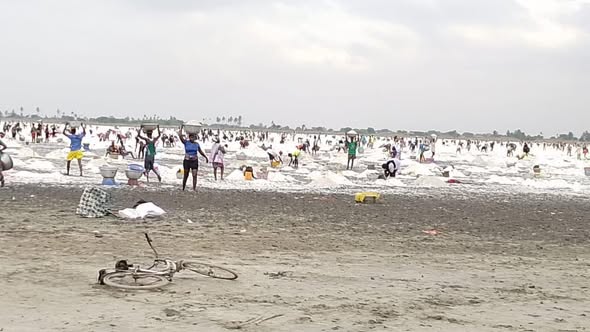
In southeastern Ghana, the Denu market is more than a place to buy and sell fish. Located approximately seven kilometres from the Ghana-Togo border, it connects local fishing communities with traders and consumers in neighbouring countries.
Women play a central role in this supply chain. After fishermen bring their catches ashore, women purchase, process and distribute the fish. Common products include anchovies and sardinellas, which are sold fresh, smoked or sun-dried.
These traditional processing methods have an important commercial function. By extending shelf life without requiring refrigeration, they allow traders to transport fish over longer distances and serve customers who may not have access to cold-storage facilities. Research indicates that smoke-dried anchovies can remain usable for up to one year under appropriate conditions (Rouillé et al.).
The market also benefits from established regional demand. Ghanaian fish traders regularly supply customers in Lomé, where fish from Ghana contributes to local food consumption.
However, this business environment presents challenges. Small traders often operate with limited working capital, depend on personal relationships, and face transportation costs and uncertain border procedures. Their commercial success therefore depends on more than the availability of products. It also depends on their ability to manage relationships and information across borders.
The Challenge: When Borders Close, Business Networks Matter
The COVID-19 pandemic exposed the vulnerability of this trading system.
On 22 March 2020, Ghana closed its land borders to human traffic. The Ghana–Togo border reopened on 28 March 2022. During this period, ordinary cross-border trading activities were severely disrupted (Rouillé et al.).
To understand the consequences, researchers conducted fieldwork in Ghana between August and October 2021. Their study involved 34 participants, including 30 traders who completed a survey and four participants in a group interview. The research included Ghanaian and Togolese women involved in cross-border fish trading.
The findings reveal the scale of the economic pressure. Among the 30 survey participants, 29 reported a decline in income during the first two months of the pandemic, including 22 who described the decrease as substantial.
Yet some traders managed to maintain business activities by activating existing social networks.
One particularly revealing case involved a Ghanaian trader who regularly sold fish in several Togolese markets, including Kpalimé, Glei, Datcha, Anie and Atakpamé. Her trading trips could last between three and seven days, depending on expected profits and the quantity of fish available. Having relatives in Togo and access to a family house in Datcha reduced her accommodation costs and made longer trading trips possible.
This example demonstrates how family relationships can become practical business resources. They provide accommodation, local knowledge and access to established commercial environments.
The study also found that mobile phones became increasingly important during the border closure. Traders contacted customers before travelling to confirm prices, quantities and delivery arrangements. Some exchanged telephone numbers with new customers to maintain relationships beyond face-to-face transactions (Rouillé et al.).
These practices reveal that trust is not simply a cultural characteristic. It is a form of business capital that helps entrepreneurs manage uncertainty.
Business Analysis: Turning Local Knowledge into Commercial Value
The experience of Denu’s women fish traders reveals three important business mechanisms.
First, traditional knowledge creates product value.
Smoking and sun-drying fish are not merely inherited cultural practices. They are practical processing methods that reduce dependence on refrigeration and make products easier to transport and store.
For small businesses operating with limited infrastructure, this represents an important competitive advantage. Improving product quality, hygiene and packaging could further increase market opportunities without abandoning established processing knowledge.
Second, social networks reduce transaction costs.
The traders’ relationships with fishermen, customers, transporters and relatives help them obtain market information, identify reliable partners and coordinate deliveries.
These networks also support informal credit arrangements. Before the pandemic, ‘informal trade credit and deferred payment arrangements were common. However, when borders closed, some traders struggled to recover outstanding payments. One participant managed to retrieve money owed by Togolese customers with assistance from fellow traders who continued travelling to Lomé (Rouillé et al.).
This demonstrates both the value and limitations of trust-based business relationships. Networks can facilitate transactions, but without proper financial records, entrepreneurs remain exposed to payment risks.
Third, market adaptability supports business resilience.
The trader who travelled between several Togolese markets illustrates how small businesses can respond to differences in demand and prices. Rather than relying on one destination, she adjusted her selling arrangements according to expected returns.
However, flexibility alone cannot protect traders from institutional barriers. The 2021 study documented unofficial border payments, harassment and additional transportation costs. Some traders continued operating at significantly reduced profit margins to maintain customer relationships.
Therefore, the real lesson is not that informal networks can solve every business problem. It is that local commercial knowledge deserves recognition and should be supported by reliable institutions.
Recommendations: From Local Networks to Sustainable SMEs
The experience of Denu’s traders offers practical lessons for entrepreneurs and policymakers.
For small business owners:
- Document transactions. Record customer orders, outstanding payments, supplier costs and delivery arrangements. Digital bookkeeping can turn established trust relationships into a more reliable business history.
- Diversify customer networks. Maintain relationships with regular buyers while exploring additional markets to reduce dependence on a limited number of customers.
- Improve product standards. Invest in hygienic processing, consistent quality and suitable packaging while preserving locally developed production knowledge.
- Use digital communication strategically. Mobile phones can help traders confirm demand, negotiate prices and coordinate transportation before committing working capital.
For governments and development organizations:
- Improve border transparency. Publish clear information about customs procedures, official fees and traders’ rights in accessible local languages.
- Recognize trader associations. Work with existing business networks when designing training programmes and trade policies.
- Expand financial services. Develop accessible working-capital products and financial literacy programmes for women-led micro and small businesses.
- Strengthen market infrastructure. Support affordable storage, sanitation, transportation and processing facilities.
The developments in June and August 2026 suggest that institutional engagement is possible. In June 2026, Ghana’s Customs Commissioner met members of the Cross-Border Women Traders Association in Aflao following concerns about illegal extortion and excessive checkpoints. The authorities reiterated that unofficial payments were unlawful and that legitimate exports to Togo were not subject to customs duty (Ghana Information Services Department).
Similarly, in August 2026, ECOWAS held a dialogue at the Noépé–Akanu Joint Border Post, bringing together border officials, traders, transporters and representatives of women and youth from Ghana, Togo and Benin. The discussions focused on improving border procedures, digitalization and regional trade facilitation (ECOWAS).
These initiatives provide opportunities to connect traders’ existing commercial networks with more predictable institutional support.
Conclusion: Supporting What Already Works
The women fish traders of Denu demonstrate that small businesses can develop effective commercial systems through local knowledge, social relationships and practical innovation.
Their experience also reveals an important limitation: trust cannot compensate indefinitely for inadequate infrastructure, financial exclusion or unpredictable border procedures.
For African SMEs, sustainable growth does not necessarily begin by replacing existing business practices. It can begin by understanding what local entrepreneurs already do well, documenting their strengths and connecting them with better financial and institutional opportunities.
For governments and development partners, the priority should be to build on these foundations through collaboration rather than imposing solutions disconnected from local realities.
The goal is not to replace local business wisdom, but to help it grow.
References
ECOWAS. ”Strengthening Regional Integration: ECOWAS Holds High-Level Dialogue and Sensitisation at Noépé-Akanu Joint Border Post.” Economic Community of West African States, 18 Aug. 2026, www.ecowas.int/strengthening-regional-integration-ecowas-holds-high-level-dialogue-and-sensitisation-at-noepe-akanu-joint-border-post/.
Ghana Information Services Department. “Customs Commissioner Assures Aflao Women Traders on Illegal Border Extortion.”Information Services Department, 9 June 2026, www.isd.gov.gh/customs-commissioner-assures-aflao-women-traders-on-illegal-border-extortion/.
Rouillé, Maïlys, Ragnhild Overå, and Amy Atter. “When Borders Close: Social Networks, Resilience and Food Security among Informal Cross-Border Fish Traders on the Ghana-Togo Border.” Maritime Studies, vol. 23, 2024, article 36. https://doi.org/10.1007/s40152-024-00378-w.