
How can a centenary infrastructure be rethought and modernized by adapting to 21st century challenges and opportunities? By focusing on rare earth mining prospects, the modernization project of the Lobito Corridor, challenged by local and international threats, can be a transformative opportunity for Southern African countries contributing to competitiveness and internationalization of local economies.
In this article, the history, challenges and opportunities of the Lobito Corridor will be analysed, focusing on past and current modernization projects lead by international powers (China, European Union and United States).
Lobito Corridor
The Lobito Corridor is a rail, road and logistical infrastructure that spreads from Lobito to Kapiri Mposhi. This 1300 km long infrastructure links the south of Angola, to the south of the Democratic Republic of Congo (DRC) and north of Zambia, connecting mining facilities, logistical interposes, strategic industries, urban settlements and the seaport of Lobito. It is one of the strategic infrastructure corridors in Southern Africa, along with Beira, Nacala, Maputo, Mtwara, Tazara, Malange and the Walvis Bay-Ndola-Lubumbashi corridors (United Nations Zambia).
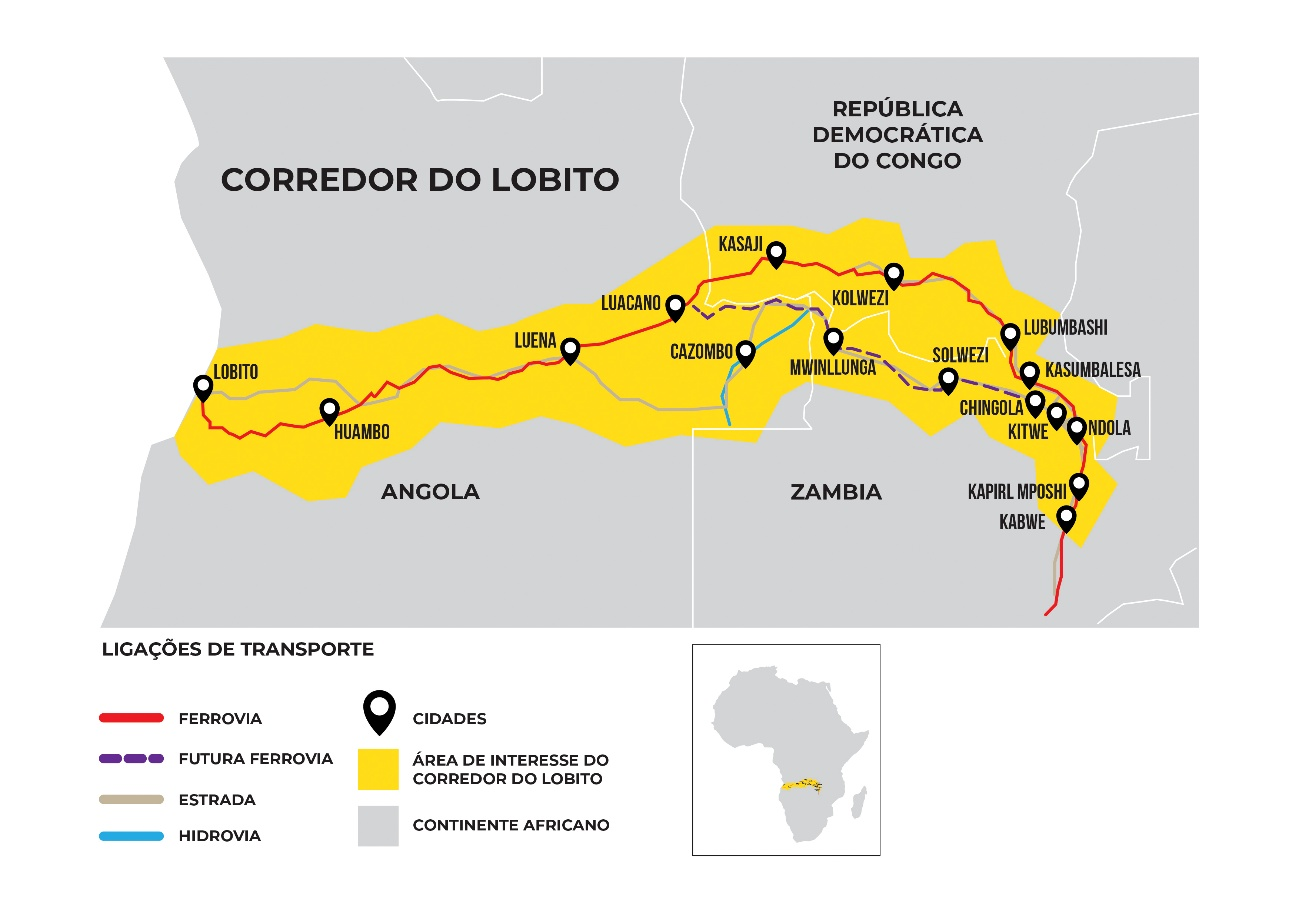
Source: (Corredor do Lobito)
The origins of the corridor date back to 1889, when the Benguela Railroad started to be built, by 1929 the railroad connected Lobito with the city of Kantaga, in the now Democratic Republic of Congo. After the Independence of Angola in 1975, the infrastructure and operations of the railway were profoundly affected, mostly because of the Angolan civil war. From 2004 to 2014, the Angolan government and the China Railway 20 Bureau Group Corporation began reconstructing and modernising the line, which required an investment of 2 billion US Dollars with the expectation to handle 4 million passenger trips and 20 million tons of cargo every year (Jiang Feifan, Marianna Lunardini and Darlington Tshuma; OECD; United Nations Zambia).
By 2022, the Ministry of Transport of Angola contracted the cargo exploitation of the railway with the international consortium (Mota-Engil from Portugal, Trafigura from Singapore and Vecturis from South Africa) Lobito Atlantic Railway, aiming to foster the import and export capabilities of the infrastructure with the European and North American markets. This new strategy of international cooperation, aiming to develop the export of minerals to Europe and the United States, led to the signature of a Memorandum of Understanding for 1.6 billion US Dollars investment between the African Development Bank, the African Finance Corporation, the European Commission, the United States Government, the Angolan Government, the DRG Government and the Zambian Government (African Development Bank Group). The Memorandum emphasises the investment in infrastructure, agriculture and mineral extraction between the signing parties (Directorate-General for International Partnerships, United States Department of State).
The project will promote industrial development, create new job opportunities, contribute to the competitiveness of the local economies and facilitate accessibility to international markets. The objectives of the project align with the United Nations Sustainable Development Goals in three key areas.
Infrastructure modernization and accessibility improvements support the 9th goal, transborder infrastructural developments that, through international cooperation, aim to contribute to the economic development helps to achieve targets 9.1 and 9.a.
Infrastructural development will add gain to the economic development of the cross-border region reinforcing the 8th goal and 12th goal, at the entrepreneurial and labour boosts new business opportunities and grant high-value labour-intensive jobs strengthening the targets 8.2 and 8.3, at the production level enables the proximity of mining facilities to production plants, reducing the cost and footprint of material transport, which foster the targets 8.4 and 12.2, and at the international markets prospects new commercial opportunities will emerge from the infrastructural modernization, either in trade or in tourism, adding value and competitiveness to local entrepreneurial projects, witch fosters the targets 8.9 and 8.a.
Challenges
Despite all the ambitious objectives of the modernisation projects of the Lobito Corridor, different challenges emerge that undermine the full development potential of the transboundary corridor. From legal and coordination barriers to trade fluxes and multiple players competition, the corridor has been facing challenges in the past decades to deliver its full potential to local communities and enterprises and to the national states.
Firstly, the shipping movements at the Lobito Port have been coming to a decline since 2013. This decrease reflects the lack of competitiveness of the corridor with other regional shipping corridors. Despite the modernisation investments by the China Railway 20 Bureau Group Corporation, the lack of foreign investment and the petrol dependency of the Angolan economy meant a decrease in the capability to export mineral ore from the DRC and Zambia via Lobito (Marianna Lunardini and Darlington Tshuma; OECD).

Font: (Porto do Lobito)
Secondly, as the corridor is a transnational multi-corporation infrastructure, the legal and administrative challenges can pose a barrier to financing and cooperation. As posed by the United Nations Zambia Policy Brief (2024), the border crossings of the corridor can pose different challenges in the political agenda, legislative framework and administrative capacity. These issues are prone to occur in a complex operational environment that is the current Lobito Corridor, where different national operators explore the infrastructure and multiple global enterprises are directly influenced by the corridor.


Font: (E. D. Wala Chabala and Judy Hofmeyr)
Thirdly, the operational and modernisation programs of the infrastructure are heavily dependent on foreign global funds. The high involvement of foreign finance may seem, at first glance, an opportunity to foster international cooperation and enhance development compromises. Represents dependency within international agendas of foreign development aid. Major infrastructure projects, such as the Lobito Corridor, depend on long-term investment strategies to achieve positive economic outcomes (United Nations Zambia). Dependency investments shaped by geopolitical interests in the region may create a volatile economic development framework in the corridor, undermining the project’s economic potential (E. D. Wala Chabala and Judy Hofmeyr).
Finally, the environmental impacts of infrastructural developments and mining operations are amongst the main criticisms. Rare earth minerals, mainly cobalt, are mainly produced by the DRC, which is the largest producer in the world, contributing to 70% of all explorations of this mineral (UN Environment Programme). Rare earth minerals are very important to the world economy, in components of technology and sustainable energy industries. However, the exploration, transport and disposal are very expensive and energy-consuming (UN Environment Programme). The extensive exploitation of natural reserves represents a serious threat to the degradation of ecosystems and poses a threat to the public safety of local communities.
Future Opportunities
Despite the challenges faced by local and international factors, the Lobito Corridor can be a unique opportunity to foster economic specialisation, accessibility and climate action.
Regarding economic specialisation, the investment in the mineral transportation and shipment from Zambia and the Democratic Republic of Congo to the international port of Lobito is a great opportunity to open new international markets to interior regions. The legal and administrative barriers could be mitigated by the constitution of a common administrative body, by the three countries, that oversees the implementation of the mutual agreement, with the objective of contributing to equal accessibility of all to international markets and facilitate the transportation of goods.
The investment in a transboundary infrastructure will provide new mobility opportunities, improving accessibility from rural areas to urban centres and between urban centres. The Lobito corridor stretches from densely populated areas, mainly in Angola, connecting Benguela, Huambo, Bié, Moxico e Moxico Leste regions, which account for around 8 million people in total (Corredor do Lobito). The investments in modernisation and expansion of the corridor must not be seen as mere trade opportunities, but also as driving means of economic transformation and specialisation in activities that relieve labour-intensive and highly qualified jobs, such as infrastructure maintenance, transformative industries and tourism or leisure activities.
When it comes to environment, understanding the impacts of over exploitation of resources and the risks of rare earth minerals mining it’s an important step to reflect about the importance of o the Lobito Corridor to the global economy. Underlining the role that must have, not as a means to accelerate the degradation of environments, but as a part of a path to a more sustainable economy of mining and renewable energy infrastructure production. For instance, the corridor grants shorter access to mining resources from North America and Europe, which leads to reduced resource consumption for transportation, adding the possible electrification of rail transport to the reduction of the ecological footprint. Similarly, the proximity to mining facilities leads the way to the implementation of economic activities of the transformation sector, namely, of lithium batteries production, along the corridor, resulting in a more efficient production system (United Nations Zambia).
Conclusion
There is no doubt that the Lobito Corridor is a strategic political and economic infrastructure for Angola, the Democratic Republic of Congo and Zambia, or to the Southern African as a whole, in a multiplicity of levels such as trade, mobility, labour, competitiveness, entrepreneurship and sustainable transformation.
Geopolitical, environmental and legislative challenges are amongst the major threats that will be faced in the near future determining the project’s goal’s success. As result of the international financing dependency of the multiple modernization projects, the current United Sates and European Union joint financial investments can rapidly be shifted to different international policies according to new international interests on an even more unpredictable political international framework.
Nevertheless, the impacts on an infrastructure linked with the trade of rare earth minerals can influence local economies at a long-term opening new entrepreneurial opportunities in specialised economic sectors and highly qualified jobs. Throw cooperation, administrative and legislative coordination and competitiveness, the Lobito Corridor can be a sustainable development galvanizer for the region and transform social and economic activities for generations.
Reference List
African Development Bank Group. African Development Bank Joins Global Partners to Raise Financing for $1.6 Bn Multinational Lobito Transportation Corridor Programme. Oct. 2023, https://afdb.africa-newsroom.com/press/african-development-bank-joins-global-partners-to-raise-financing-for-16-bn-multinational-lobito-transportation-corridor-programme.
Chabala, E. D. Wala, and Judy Hofmeyr. ‘A Game Changer in Flux: Recent Developments and Risks in the Lobito Corridor’. Africa Policy Research Institute, 2025, https://afripoli.org/a-game-changer-in-flux-recent-developments-and-risks-in-the-lobito-corridor.
Corredor do Lobito. Corredor do Lobito. https://corredorlobito.com/. Accessed 18 June 2026.
Corredor do Lobito. Indicadores. https://corredorlobito.com/indicadores/. Accessed 18 June 2026.
Directorate-General for International Partnerships. Global Gateway: EU Scales up the European Engagement in the Lobito Corridor – Global Gateway Forum. Oct. 2025, https://global-gateway-forum.ec.europa.eu/news/global-gateway-eu-scales-european-engagement-lobito-corridor-2025-10-10_en.
Feifan, Jiang. ‘Chinese Enterprises Have Facilitated International Trade 34 Years Later by Revitalizing the Benguela Railway’. Belt and Road Portal, Nov. 2022, https://eng.yidaiyilu.gov.cn/p/290507.html.
Lunardini, Marianna, and Darlington Tshuma. ‘The Lobito Corridor and Africa’s Development Agenda: Synergies with the Mattei Plan and Global Gateway’. Istituto Affari Internazionali Briefs, no. 26|01, Jan. 2026.
OECD. The Lobito Corridor. OECD, Apr. 2025.
Porto do Lobito. Boletim Estatístico – Porto do Lobito. https://portodolobito.co.ao/boletim-estatistico/. Accessed 18 June 2026.
United Nations Zambia. Potential Impact of the Lobito Corridor and Support to the Regional Transformation Agenda. Oct. 2024, https://www.undp.org/sites/g/files/zskgke326/files/2024-10/lobito-corridor-policy-brief.up_.pdf.
United States Department of State. ‘Joint Statement Declaration of Intent from the United States Government and the European Commission on the Lobito Corridor and Investment in the Great Lakes Region’. United States Department of State, Dec. 2025, https://www.state.gov/releases/office-of-the-spokesperson/2025/12/joint-statement-declaration-of-intent-from-the-united-states-government-and-the-european-commission-on-the-lobito-corridor-and-investment-in-the-great-lakes-region/.