
African SMEs’ Green Transition: Evidence Before Investment

African SMEs’ Green Transition: Evidence Before Investment

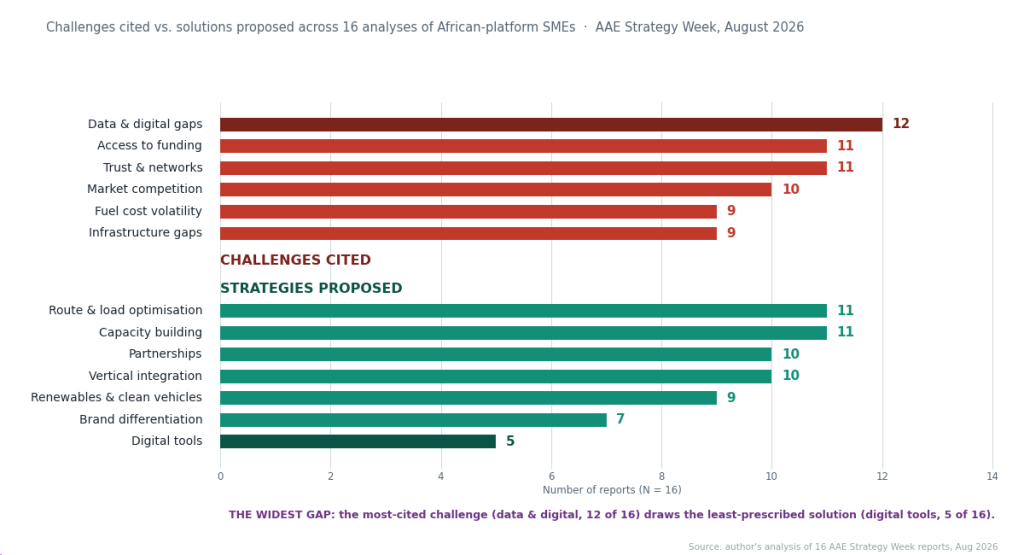
Between 24 August and 4 September 2026, sixteen students in the African Association of Entrepreneurs (AAE) Strategy Week program each analyzed one entrepreneur listed on the AllAfripreneurs platform. Read together, their reports point to a single lesson: for African SMEs, the green transition is won by efficiency and evidence first, and capital second. The most widely cited challenge—data and digital gaps—is also the one that proposed solutions address least. This report summarizes what the sixteen analyses agree on, where they disagree, and what SME owners and platform builders can do next.

Green Logistics and Clean Energy Business Upgrade for South African SME Archibald Zele

Green Logistics and Clean Energy Business Upgrade for South African SME Archibald Zele

This report explores green‑business upgrading for Archibald Zele, a South‑African SME operator running both logistics and clean‑energy businesses. His enterprise suffers from disconnected business lines, fossil‑fuel‑driven high operational costs, under‑monetised clean‑energy assets and resource waste caused by inefficient logistics operations. This article proposes a practical circular green‑logistics model: integrating clean‑energy hardware with delivery fleets, optimising supply‑chain workflows, and building local low‑carbon service branding. Requiring no drastic industrial overhaul, this solution brings commercial, environmental and social value, offering a replicable sustainable growth reference for grassroots logistics SMEs in South Africa.
Greener Cross-Border Logistics for Zele Eco-Energy Works

Greener Cross-Border Logistics for Zele Eco-Energy Works

Cross-border road freight supports regional trade, but smaller operators face unstable fuel costs, border delays, limited digital tools and pressure to reduce emissions without weakening margins. This report examines Archibald Zele's enterprise through external opportunities and threats, a practical green business model, and a China-Africa cooperation project. It recommends better operational data before expensive vehicle replacement. A South Africa-Mozambique pilot could test whether route planning, load matching and basic tracking tools reduce fuel use and empty kilometres while protecting delivery reliability.
Clean Energy Logistics: A Green Business Model for Southern African SMEs

Clean Energy Logistics: A Green Business Model for Southern African SMEs

This case study demonstrates that green business models in Africa are pragmatic, local-driven innovations rather than imported frameworks. Zele’s path – prioritizing operational efficiency first, then expanding into clean energy verticals – provides a replicable template for logistics SMEs across southern Africa. Through this research, we recognize that African entrepreneurs play the central role in advancing regional sustainable development. Local, problem-solving innovations form the core momentum of Africa’s green transition. Targeted green financing support and improved cross-border clean infrastructure will further unlock the growth potential of sustainable SMEs across the continent.