
Abstract
Why do more than 70% of small businesses in Kenya fail within their first three years? It is not due to the lack of capable businesses but the difficulty of accessing finance. Although small businesses form the backbone of Kenya’s economy, around 79% operate informally and often lack the documentation, credit histories, or property titles that traditional lenders require. [1] As a result, the financing gap of SMEs in Kenya stands at approximately $17 billion. [2]
Today, Kenyan entrepreneurs are finding new ways to prove their creditworthiness. Every day, they create digital records through mobile money transactions, utility payments, inventory purchases, and online sales. These activities reveal patterns of reliability, financial discipline, and business performance that traditional lending models often overlook. This article examines how by aggregating data from everyday business activity into a 360-degree digital identity can help overcome this financial barrier. This operations-led credit ecosystem has the potential to unlock capital and expand opportunities for SMEs across Kenya.
1. Background: The Landscape of SME Credit in Kenya
The heavy reliance of Kenyan banks on collateral requirements contributed to the staggering credit gap, which locks the majority of SMEs from formal loans. According to a survey conducted on the SMEs of Meru County in Kenya, 83% of all the respondents could not afford the collateral required by the financial institutions. [1]
To overcome this challenge, we can utilise the growing digital presence of Kenyan individuals. As of June 2025, Kenya has achieved a 91% market penetration in mobile money. [2]
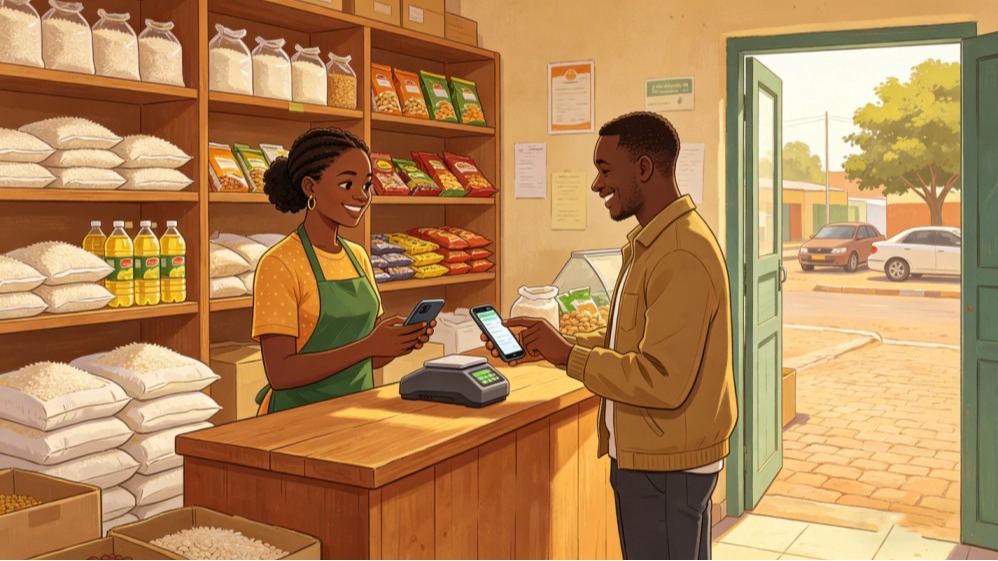
Analyses of adoption of mobile money among SMEs show that about two-thirds (66%) of the enterprises use mobile money services daily, predominantly to pay business bills such as electricity, water, etc. (94% of enterprises), pay suppliers (90%), rent (64%) and employee salaries (63%) and receive payments from customers (88%). Around 50% of the enterprises use internet banking, mainly to pay suppliers and receive payments from customers. [3]
2. Challenges: Fragmented Digital Data Adaptation
Kenya’s rapidly expanding digital economy is creating new opportunities for entrepreneurs and small businesses to establish financial credibility without relying on traditional forms of collateral. Through their daily interactions with digital platforms, business owners generate a range of alternative data that can be used to assess creditworthiness. For example, M-KOPA records repayment behaviour through pay-as-you-go purchases of solar systems and smartphones, while M-Shwari evaluates customers using mobile money transactions and savings activity. Similarly, business-to-business platforms such as Twiga Foods and Wasoko analyse inventory purchases and sales cycles to extend working capital to retailers. Digital lenders, including Tala, also utilise smartphone and mobile wallet data to assess borrowers who may lack formal credit histories.
These innovations have expanded access to finance for many entrepreneurs who were previously excluded from conventional banking services. By leveraging alternative data, digital financial providers can better understand the economic activities of small businesses and offer credit based on demonstrated behaviour rather than physical assets.
However, a significant challenge remains. Much of this digital information is confined within individual platforms, creating fragmented data ecosystems. Each provider captures only a limited view of an entrepreneur’s financial activities, making it difficult to build a comprehensive picture of business performance. As a result, a retailer with a strong repayment record on one platform may still struggle to access financing elsewhere because that positive history cannot easily be verified or transferred.
For Kenyan entrepreneurs, this fragmentation limits the full potential of digital finance. Addressing data-sharing barriers and improving interoperability between financial platforms could help small businesses leverage their complete digital track record, ultimately expanding access to affordable credit and supporting business growth across the country.
3. Case: Lessons from India and Emerging Developments in Kenya
3.1 Case Study – Account Aggregators from India
India, a developing lower middle-income economy similar to Kenya, has faced similar problems in extending formal credit to the informal sector. To overcome this issue, India has built the Account Aggregator (AA), which is a consent-based framework for securely sharing financial data with the lenders. By early 2026, the network had grown to more than 272 million linked accounts and had around 1000 member participants. [6]
While Kenya’s economic and regulatory environment is different, some of the underlying principles may be relevant. As the country advances its National Payments Strategy, fintech could potentially help entrepreneurs share verified transaction histories with lenders through advanced infrastructures.
3.2 Translating Operational Behaviour into Credit History: The “360-Degree” Advantage
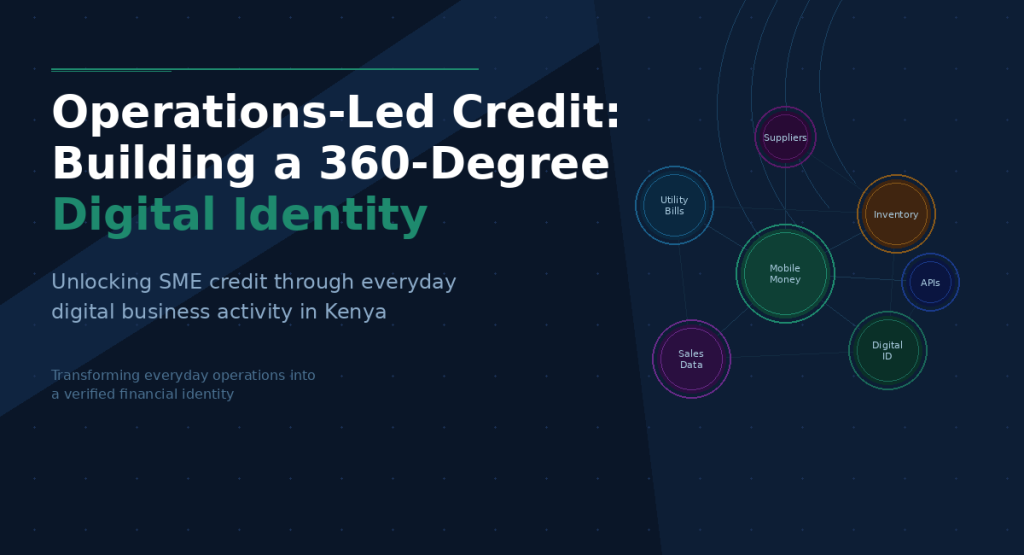
A major limitation of Kenya’s current digital lending ecosystem is the fragmentation of data across multiple platforms. Addressing this challenge would require the development of more comprehensive business profiles that integrate information from mobile money services, utility providers, suppliers, and digital marketplaces. By bringing together these diverse data sources, lenders could gain a more complete understanding of an entrepreneur’s financial activities and business performance.
The primary advantage of this approach is that it evaluates businesses through multiple indicators rather than relying on a single source of information. This can produce a more accurate and balanced assessment of creditworthiness. For example, a temporary decline in sales caused by adverse weather conditions might make a business appear financially vulnerable if a lender considers only purchase or supplier transaction records. However, when this information is viewed alongside a consistent history of timely utility payments and other positive financial behaviours, the same business may demonstrate strong financial discipline, stability, and resilience.
For small entrepreneurs, a more holistic assessment framework could reduce the risk of being unfairly excluded from credit opportunities due to short-term fluctuations in business activity. As a result, integrated digital profiles have the potential to improve financial inclusion and expand access to growth-oriented financing for businesses across Kenya.
3.3 An Institutional Innovation from Kenya
Early steps for an operations-led complete credit profile are already visible in Kenya today. Initiatives like Open Finance and the National Payments Strategy are aiming to enhance interoperability between banks, mobile money providers, fintech companies, and other financial service providers. [7]
At their core, these initiatives are trying to enable institutions to access user consented data more efficiently while also providing greater control on individuals financial data. Although this framework is still developing, this lays a foundation towards creating a comprehensive financial identity by integrating broader data sources from utility and digital sales platforms.
4. Suggestions – Building a Sustainable Operations-Led Credit Ecosystem
4.1 Establishing a Connected Financial Data Infrastructure
To create a 360-degree digital identity, Kenya’s financial sector needs to switch from using many different sources of data to a more connected system. Currently, all the valuable information generated through daily transactions, bills and purchases is scattered across different platforms. This limits the lenders from gaining a holistic view of the business strength.
A first step to overcome this challenge is establishing greater collaboration between financial institutions, fintech companies, mobile money providers and other digital platforms. Through governmental initiatives like the National Payment Strategy, secured APIs and cross-platform communication can allow data to be shared safely across financial lenders. This will help entrepreneurs build a more complete financial identity that can speak for their creditworthiness.
4.2 Leveraging AI and Alternative Data for Better Credit Decisions
Once financial data from different platforms can be extracted, Machine Learning (ML) and Artificial Intelligence (AI) can help create meaningful credit insights from these isolated data points. By analysing patterns across transactions, utility payments, inventory purchases, sales activity, and cash flow behaviour, these algorithms can predict the business stability and risk involved.
This broader information about the borrower will make credit assessments more accurate and lower the underwriting costs for the lender. A dynamic source of data also provides lenders with an opportunity to adapt better to market conditions.
4.3 Building Trust Through Governance, Security, and Financial Literacy
To build a sustainable operations-led credit ecosystem, it is essential to build trust among all the participants and in the system as a whole. As more financial data is involved, there must be clear rules to ensure that information is collected, stored, and used responsibly.
Financial institutions also need strong security systems and fraud detection tools to protect both lenders and borrowers. A survey conducted by TransUnion in late 2024 reported that more than 80% of Kenyans surveyed reported being targeted by online scams. Measures such as Multi-Factor Authentication (MFA), biometric verification, and greater awareness can help reduce these risks and gain confidence in digital finance. [8]
Financial literacy also plays an important role. When entrepreneurs understand how their data is used to evaluate their profiles, they can actively participate in strengthening their digital financial identity through responsible online presence. Fintech platforms can support this process through user-friendly dashboards and tools that help business owners track and improve their progress. Together, strong governance, security, and financial awareness can create a trusted and sustainable foundation for operations-led credit.
5. Conclusion
Operations-led credit has the potential to reshape the access to financial assistance for the Kenyan MSME owners. As the digital landscape in Kenya broadens, this is also a chance for financial inclusion for those without formal assets. By transforming daily operations into a 360-degree digital identity, Kenyan entrepreneurs will have the opportunity to confidently demonstrate their business viability to receive loans.
For establishing and scaling this opportunity, continuous collaboration between the fintech providers, policymakers and the borrowers is required. Responsible regulations, data governance, customer protection and financial literacy will be essential in building a strong and long-term digital credit ecosystem. With these foundations in place, Kenya is well positioned to build a more inclusive financial system that supports sustainable economic growth in the MSME sector.
References
[1] “The Informal Economy: Kenya’s Real Employer.” Nation Africa, Nation Media Group, https://nation.africa/kenya/news/the-informal-economy-kenya-s-real-employer-5281846. Accessed 7 June 2026.
[2] Kenya Bankers Association. State of the Banking Industry Report 2023. Kenya Bankers Association Centre for Research on Financial Markets and Policy, Aug. 2023, https://www.kba.co.ke/wp-content/uploads/2023/08/KBA-State-of-the-Banking-Industry-Report-2023.pdf. Accessed 7 June 2026; Christiansen, John. “SME Lending in Africa: Alternative Data Drives Credit Decisions.” ezbob, 11 Feb. 2026, https://ezbob.com/sme-lending-in-africa-alternative-data-drives-credit-decisions/. Accessed 7 June 2026.
[3] Kaimenyi, Muriungi Silas. “Influence of Collateral Requirements on Performance of SMEs Business in Meru County, Kenya.” International Journal of Accounting, Finance and Risk Management, vol. 10, no. 1, Feb. 2025, pp. 62–71, https://www.sciencepublishinggroup.com/article/10.11648/j.ijafrm.20251001.14. Accessed 7 June 2026.
[4] Elliot, Natalia. “Kenya’s Mobile Money Market Hits 91% Penetration.” FinTech Magazine, 25 Sept. 2025, https://fintechmagazine.com/news/kenya-leads-the-world-in-mobile-money-penetration. Accessed 7 June 2026.
[5] Kenya Bankers Association and Japan International Cooperation Agency. Micro, Small and Medium Enterprises (MSMEs) Survey Report 2021. Kenya Bankers Association Centre for Research on Financial Markets and Policy, June 2021, https://www.kba.co.ke/wp-content/uploads/2022/05/MSMEs-Survey-Report.pdf. Accessed 7 June 2026.
[6] Sahamati. “Account Aggregator Network.” Sahamati, https://sahamati.org.in/. Accessed 7 June 2026.
[7] Central Bank of Kenya. National Payments Strategy 2022–2025. Central Bank of Kenya, Feb. 2022, https://www.centralbank.go.ke/wp-content/uploads/2022/02/National-Payments-Strategy-2022-2025.pdf. Accessed 7 June 2026.
[8] TransUnion Africa. “More Than Four-Fifths of Kenyans Said They Were Recently Targeted with Fraud.” TransUnion Africa Newsroom, 2025, https://newsroom.transunionafrica.com/more-than-four-fifths-of-kenyans-said-they-were-recently-targeted-with-fraud/. Accessed 7 June 2026.