

Abstract
Social Status Literacy (SSL) is introduced as a practical framework for understanding why many businesses fail despite access to funding, skills, or ambition. SSL describes an entrepreneur’s ability to identify their current position within the market hierarchy and align offerings, pricing, communication, and operations with the social and economic status of their immediate audience. The framework emphasizes that business growth is sequential and audience-driven rather than aspirational. By outlining four progressive audience stages Immediate, Loyal, Transitional, and Main Market SSL provides entrepreneurs and practitioners with a tool to reduce premature scaling, strengthen market fit, and support sustainable growth. Brief applied case insights from the Dangote Group and Mr Bigg’s in Nigeria illustrate how literacy or illiteracy in social status directly influences long-term business outcomes.
Introduction
High business failure rates persist across emerging and developed economies. Studies estimate that a significant percentage of startups fail within their first few years of operation, often due to weak market fit and poor strategic alignment (Founders Factory Africa). While inadequate financing, leadership gaps, and operational weaknesses are commonly cited explanations, these factors frequently mask a deeper issue: misalignment between a business’s growth stage and the social status of the audience it seeks to serve.
Many entrepreneurs attempt to position their businesses for markets they are not yet equipped to satisfy. This misalignment results in brand rejection, operational strain, and financial losses that are often misinterpreted as external market failure. Social Status Literacy (SSL) addresses this gap by focusing on an entrepreneur’s capacity to correctly identify their current market position and respond appropriately to audience expectations at that level.
Business growth is inherently staged. Each stage requires distinct levels of operational discipline, pricing logic, and value delivery. Businesses that attempt to bypass these stages often experience premature scaling, a leading cause of failure among small and growing enterprises (Sutton and Kellow 64). SSL provides a structured lens through which entrepreneurs can evaluate readiness, avoid misaligned expansion, and pursue growth that is intentional and sustainable.
The Social Status Literacy (SSL) Framework
SSL organizes business growth into four sequential audience stages. Progression occurs only when the expectations of each stage are consistently met and validated.
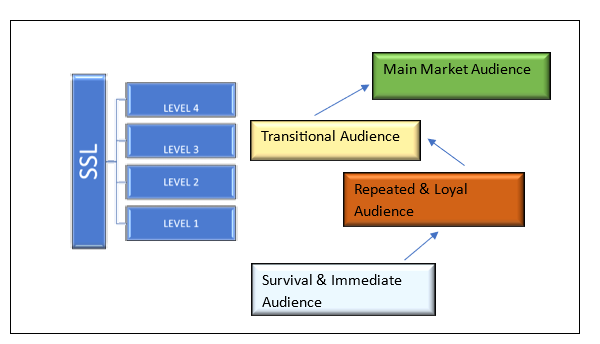
Fig 1.1
Level 1: Survival and Immediate Audience
Focus: Relevance and consistency
At this foundational stage, businesses serve their most accessible audience—customers who are socially, geographically, or economically closest. The primary objective is acceptance rather than scale.
Key requirements include:
- Simple and uniform offerings
- Pricing aligned with audience purchasing power
- Direct engagement and feedback
- Consistent delivery of a core value
At this stage, introducing excessive variety or premium positioning often weakens focus and erodes trust. SSL emphasizes that early stability is a prerequisite for future growth (Liberto).
Level 2: Repeated and Loyal Audience
Focus: Trust and reliability
At this level, customers return voluntarily, and demand becomes predictable rather than incidental. Trust becomes the dominant currency of growth.
Key requirements include:
- Consistent product or service quality
- Reliable service delivery
- Early brand recognition
- Basic operational discipline
Failure at this stage often stems from inconsistency, which weakens customer confidence and limits repeat patronage (Kotler and Keller 112).
Level 3: Transitional Audience
Focus: Referral-driven learning
The business begins to attract segments of its intended long-term market, often through referrals from satisfied customers. This stage reveals whether the business truly understands what its audience values.
Key requirements include:
- Clearer positioning and messaging
- Adjustment of offerings based on evidence rather than assumptions
- Refinement of operations rather than rapid expansion
SSL frames this stage as one of recalibration. Businesses that ignore feedback at this point often misinterpret early referrals as readiness for scale (Sutton and Kellow 71).
Level 4: Main Market Audience
Focus: Structured and scalable growth
The business is now aligned with its core target audience. Demand is validated, and systems can support expansion.
Key requirements include:
- Defined pricing tiers and product packaging
- Scalable systems and processes
- Strong brand clarity and consistency
- Intentional expansion strategies
Growth at this level is sustainable because it is supported by verified demand and operational readiness (World Bank, SMEs Finance).
Strategic Value of SSL
SSL integrates three interdependent dimensions of business decision-making:
Resources: Human capital, systems, infrastructure, and funding must match the audience served. Overinvestment at early stages increases risk rather than competitiveness (World Bank, Industrialization).
Environment: Cultural norms, competition, regulation, and location shape consumption behavior and influence trust.
Socioeconomic Status: Income levels, education, and lifestyle patterns determine what customers perceive as value (Akinyoade 148).
Misalignment across these dimensions is a frequent cause of business failure. SSL provides entrepreneurs with a practical tool to align ambition with capacity.
Core Business Contradictions Through the SSL Lens
Funding Demand vs. Business Capacity
Many entrepreneurs seek funding that exceeds their operational readiness. SSL reframes funding readiness around verified audience penetration and offering maturity rather than ambition or projections (Liberto).
Static Offerings vs. Evolving Markets
As businesses move upward in audience status, offerings must evolve accordingly. Growth stagnates when products and services remain static while customer expectations shift (Kotler and Keller 118).
Premature Scaling vs. Sustainable Growth
Skipping audience stages leads to brand dilution and operational breakdown. SSL reinforces sequential growth as a non-negotiable principle of sustainability (Sutton and Kellow 67).
Applied Case Insights
Dangote Group: SSL in Practice
Key lesson: Master the immediate audience before increasing operational complexity.
The Dangote Group began as a trading enterprise supplying essential commodities to local Nigerian markets. Rather than entering manufacturing immediately, the business focused on affordability, availability, and distribution efficiency, thereby satisfying its immediate audience (Forrest 94).
Only after stabilizing demand did the company move into backward integration and large-scale manufacturing. Each expansion step aligned with an already-served market, reducing risk and strengthening competitiveness (Akinyoade and Uche 500).
SSL takeaway for entrepreneurs:
Sustainable scale is built by satisfying demand before increasing complexity.
Mr Bigg’s: Failure of SSL
Key lesson: Growth without consistency erodes trust.
Mr Bigg’s achieved early dominance as a family-oriented fast-food brand but failed to maintain consistent quality within the immediate audience in which they served, customer experience was short lived across outlets. Variations in service delivery especially in quality reduction and inconsistency, and product standards weakened consumer trust (Akinyoade 150).
As consumer preferences evolved, and moving up the ladder of SSL, the brand’s offerings remained largely unchanged, leading to relevance loss and declining loyalty (Euromonitor International).
SSL takeaway for entrepreneurs:
When trust is lost at the loyal-audience stage, recovery becomes difficult and costly.
Conclusion
Social Status Literacy provides entrepreneurs with a practical framework for understanding business growth beyond capital and ambition. By emphasizing audience readiness, sequential progression, and alignment between offerings and social status, SSL helps reduce premature scaling and improve long-term sustainability.
Businesses grow successfully not by reaching the largest market quickly, but by serving the right audience well at every stage.
Works Cited
Akinyoade, Akinola. “Fast Food Consumption and Changing Lifestyles in Urban Nigeria.” African Development Review, vol. 30, no. 2, 2018, pp. 145–158.
Akinyoade, Akinola, and Chibuike Uche. “Dangote Cement: An African Success Story?” African Affairs, vol. 115, no. 460, 2016, pp. 491–512.
Central Bank of Nigeria. Backward Integration Policy and Industrial Growth in Nigeria. CBN, 2018.
Dangote Cement Plc. Annual Report and Financial Statements. Dangote Cement Plc, 2022.
Dangote Group. Our History and Operations. Dangote Industries Limited, 2023.
Euromonitor International. Consumer Foodservice in Nigeria. Euromonitor Reports, 2019.
Forrest, Tom. The Advance of African Capital: The Growth of Nigerian Private Enterprise. University of Virginia Press, 1994.
Founders Factory Africa. “How Many Startup Businesses Fail in the First Year.” Founders Factory Africa, 8 Feb. 2024, www.foundersfactory.africa/blog/startup-businesses-fail-in-the-first-year-survival-tips.
Kotler, Philip, and Kevin Lane Keller. Marketing Management. 15th ed., Pearson Education, 2016.
Liberto, Daniel. “Small and Midsize Enterprise (SME): Definition and Types Around the World.” Investopedia, 10 Apr. 2025, www.investopedia.com/terms/s/smallandmidsizeenterprises.asp.
Sutton, John, and Ndidi Kellow. An Enterprise Map of Nigeria. International Growth Centre, London School of Economics, 2010.
UAC of Nigeria Plc. Corporate History and Brand Development. UACN Plc, 2010.
World Bank. Industrialization and Economic Diversification in Nigeria. World Bank Group, 2019.
World Bank. “Small and Medium Enterprises (SMEs) Finance.” World Bank, 7 Oct. 2025, www.worldbank.org/en/topic/smefinance.
Yemi, Olufemi. Brand Evolution and Consumer Loyalty in Nigerian Fast-Food Chains. Unpublished thesis, 2007.
Bio
Oluwabukola Lucy Adesanya is a Public Health and Business/ System Administration professional with over 15 years of experience in institutional business systems strengthening, program coordination, and policy support. Her research interests include enterprise development, consumer behavior, and industrial growth in emerging economies, with a focus on developing countries. She holds a first degree in Food science and Technology, a Post graduate diploma in corporate management, an MBA in Finance & Investment, a Chartered Administrator, a Certified professional in Health system Leadership, and a Certified Associate Project Management professional, also currently pursuing an MBA In global management. She brings a practice-informed perspective to research on industrial growth, SMEs, and business strategy in emerging economies, bridging evidence, operations, and policy for sustainable development outcomes. She also a United Nation Volunteer that support Business and Entrepreneurship growth.


