Abstract
Focusing on the emerging potential of waste from an unwanted by-product to an economic resource capable of driving green economy, sustainable development, and social wellbeing, this paper explores how the social enterprises in Ghana can leverage waste by adopting a circular economy model. The study also examines opportunities and challenges that social enterprises face in the waste economy. Despite having immense potential in the waste sector, enterprises face challenges related to finance, technology, policy frameworks, and socio-cultural barriers. The path to unlock the potential of the waste economy as an engine of sustainable development and job creation lies in addressing these challenges, dismantling the take-make-dispose model, adopting suitable policies, and empowering the informal sector.
Introduction
“Waste in the wrong hands is just trash; in the right hands, it’s an opportunity”
Globally, waste generation and management has become a concerning issue that poses risks to public health, environmental sustainability and social well-being. The mismanagement crisis is happening due to population explosion, industrialization, urbanization, and rising consumption patterns. According to a Global Waste Management Outlook 2024 by UNEP, the world produces 2.3 billion tonnes of waste annually and it is expected to generate 3.88 billion tonnes by 2050. The solid waste management costs will increase from $204 billion in 2020 to $375 billion by 2050.
The financial burden will hit low-income countries the worst. The World Bank report titled “What a Waste 2.0: A Global Snapshot of Solid Waste Management to 2025” explains the position of Africa in waste generation. The country generates 125 million tons of waste annually and if the situation continues, Sub-Saharan Africa could generate triple waste by 2050. Less than 10 percent of the waste is properly managed and recycled and 90 percent of the waste is dumped in landfills, open places and illegally burned, causing soil and environmental pollution. At the core of the waste mismanagement issue lies the “take-make-waste” linear model which is unsustainable and leading to pollution, public health and environment related issues.
In this model, raw products are extracted, turned into products and the remaining part is discarded as trash. To address the issues of waste generation and mismanagement, the countries are pivoting towards a sustainable “circular economy” model. The model is based on production and consumption that involves sharing, leasing, reusing, repairing, refurbishing and recycling
existing materials and products as long as possible.
The purpose of the study is to explore the potential of the waste sector specifically in Ghana as a valuable economic resource and engine of sustainable development. By combining the local and international data on waste economy and real-time interview material, the paper also identifies the opportunities, challenges, and offers recommendations to entrepreneurial
businesses. The paper also shows how the waste economy ridden with cultural taboos can promote national economy, social welfare, sustainable development and job creation.
Background: Waste generation, business potential, and policy frameworks in Ghana
Our analytical study focuses on Ghana as the country is currently undergoing a significant transition in its approach to waste, showing a pivot from “dump and burn” to a structured circular economy. Ghana has a population of 30 million and produces 13,000-15,000 tones of waste daily. On a yearly basis Ghana generates over 5 million tons of waste. Of all waste produced, only 10
percent is properly managed while the major chunk causes major health risks and environment degradation. Improper management of solid waste costs Ghana around $290 million, making up 1.6 percent of GDP (Ahenkan et al, 2026).
Waste composition
In terms of waste composition, Ghana holds a prominent position in organic waste which is 60 percent followed by 14 percent and 6 percent in plastics and inert materials respectively. The remaining includes miscellaneous (5 percent), paper (5 percent), metals (3
percent), glass (3 percent), leather and rubber (1 percent), and textiles (2 percent). In the case of improper dumping these waste products pose severe health risks. For instance, according to Ghana’s Ministry of Sanitation and Water Resources, of 2,000 metric tons generated plastics, only 10 percent is used in recycling. The issues related to microplastics and contamination of marine environments are on rise. Similarly, the organic waste which is not composted contributes to increased emissions of greenhouse gases. Electronic waste also worsens health risks by releasing toxic chemicals (Beyond Waste Initiative).
But, the landscape is increasingly changing as Ghana sees waste as an opportunity that needs to be explored for economic and social benefits. The Ghana government is playing an important role to strengthen the policy framework to speed up the shift from linear to circular economy models.
Role of government
The government introduces the National Solid Waste Management Strategy of Ghana as a key policy to improve the various domains of solid waste management ranging from waste production to disposal. It also emphasizes on combining solid waste management with private sector participation (UNDP, 2022).
The Republic of Ghana also published the Medium-Term National Development Policy framework (2026-2029), designed to align solid waste management with sustainable development goals. The key priorities of the policy involve:
● Establish integrated solid waste management systems
● Support the informal waste sector
● Promote waste recycling and recovery technologies
● Operationalize funding mechanisms, for example, the Plastic Waste Recycling Fund
According to a new study conducted by the Institute of Statistical, Social, and Economic Research (ISSER) at the University of Ghana, the researchers urged the government to adopt a “hybrid waste management framework” combining decentralized local waste management with large-scale private sector participation to capitalize on Ghana’s waste economy and ensure scalability (Ghana News, February 2026).
In 2025, the government also provided $300,000 to 10 small and medium enterprises. The focus of the grant was on plastic recycling and providing business support to circular economy startup and waste collection enterprises.
Opportunities offered by waste economy
The waste economy in Ghana and specifically in Africa is not just about clearing and disposing the trash; it is increasingly emerging as a multi-billion-dollar circular economy opportunity involving agriculture, energy, manufacturing and digital innovation. Organic waste accounts for 50-60% solid waste in Ghana. By processing and recycling organic waste, the enterprise can make high-grade organic fertilizer, composting, and capture methane. The opportunity of capturing methane will also help in climate mitigation.
Some enterprises in Africa especially in Kenya are adopting waste-to-protein approach in which Black Soldier Fly larvae is used to process organic waste into high protein animal feed. Decentralized anaerobic digesters in peri-urban areas are processing organic waste into biogas, as a renewable energy source for households. This waste-to-energy conversion can address energy deficits and waste overflow (AMPOMAH-BENEFO 2025, 17).
Another opportunity involves the use of “logistics-as a service” to solve the waste collection problem in densely-packed cities. Digital apps connect households to waste pickers to ensure smooth collection of waste. Moreover these digital platforms can also improve traceability of materials flow and optimize routes.
Structural challenges faced by social enterprises
Here are some challenges faced by small-to medium social enterprises.
Financial instability and macroeconomic pressures
Social enterprises often struggle with “double bottom line” where the cost of hiring marginalized workers or servicing low-income areas exceeds the companies’ profits. Access to finance is the most significant challenge, encompassing lack of capital for start-ups, high cost of capital, high transaction costs and unavailability of long-term financing (Kussi-Appiah et al, 2025).
Interest rates in Ghana are skyrocketing, making it difficult for small-to-medium enterprises to secure loans to fulfill the needs related to infrastructure and logistics. For instance, the interest rates in Ghana reached 24.5 percent in 2022 and 22.5 percent in 2021.
Infrastructure and logistics hurdles
The physical environment in Ghana also creates massive operational bottlenecks for waste collection and processing. In the country, waste management infrastructure is underdeveloped especially in peri-urban and rural areas. The communities do not have the access to proper infrastructure and logistics for waste collection, dumping, and processing. Hence, people dump these waste indiscriminately along with burning it illegally. As a result, communities suffer from grave health risks coupled with environmental degradation (Malo and Nwamadu 2024).
Socio-cultural challenges
The success of waste management also depends on the behavior of the general public. For instance, in many low-income communities, waste collection is viewed as a free government service. Even the social enterprises struggle to convince households to pay for door-to-door collection. Some other socio-cultural barriers also include lack of understanding of waste segregation, social stigma, and a persistent clash between waste collection and established concerns.
In many communities, waste collection and management is often viewed as a low-status job, making it difficult for start-ups to attract skilled management talent or professionalize their workforce. The informal sector also shows resistance to formalization. They fear that after joining the formal sector they will either be burdened with taxation or lose their independence and daily earnings.
Regulatory and Institutional barriers
The implementation of regulations and policy frameworks at local levels is often fragmented. It creates an uneven field for licensed companies, allowing unregulated entities to operate without accountability. The complicated and lengthy licensing procedures often discourage the players or start-ups from entering the regulatory framework.
Waste-to-wealth innovation: Case studies of successful businesses redefining waste
The analysis of challenges shows that exploring and leveraging the waste landscape in Africa is not easy for entrepreneurs and social enterprises. However, this is not disappointing at all. The successful stories of local startups and entrepreneurs still exist who overcame cultural taboos and initial financing challenges and became a success story. Hence, two representative success stories are evaluated to understand the waste economy better in Ghana.
Case study 1: Coliba Ghana
Coliba Ghana Ltd is one of the leading Ghanaian plastic waste recycling companies which is committed to reduce plastic pollution and protect the environment. The company is on the mission of creating sustainable plastic waste recovery and value chain and formalizing the informal plastic collection sector. In April 2025, Coliba received funding under the Circular Economy Framework for the Plastic Sector (CEF-PS). The aim of the $7 million initiative led by Ghana’s Ministry of Environment in collaboration with UNIDO, is to create 7000 job opportunities and recover 93,000 tonnes of plastic waste (African businesses heroes).
Challenges & Impact
The biggest challenge was the lack of data and trust in informal collection. Coliba overcame this challenge by integrating blockchain technology in the waste-picking sector in partnership with Plastika. The company provides a mobile and SMS-based platform where businesses and households can request a plastic waste pickup for redeemable points. Economically and socially, the company plays an important role in creating job opportunities. For instance in 2023, Coliba supported and integrated 6,200 informal waste pickers in which 85 percent are women, into their digital supply chains. Now these waste-pickers are earning a
consistent income.
Case study 2: SafiSana Ghana
Ghana is also dealing with poor sanitation conditions as approximately 28.6 percent of the population uses basic sanitation services (World Bank, 2022). About 1 in 4 Ghanaians (25 percent) practice open defecation. SafiSana began its journey in 2010 with a small-scale waste processing plant on the outskirts of Accra. The social enterprise took the responsibility of resolving the issue of sanitation and turning the waste into something valuable. In 2017, the enterprise opened the first waste-to-resource recycling plant in Ashaiman, Ghana, with the support of the African Development Bank, the Dutch Ministry of Foreign Affairs and private funds. SafiSana collects both fecal sludge and organic food waste from markets. They process the waste in a bio-digester and produce renewable energy and premium organic fertilizer.
Impact
Throughout this years-long journey, the social enterprise created a significant impact by serving 125,000 people with improved sanitation and delivering organic compost. They benefitted 11,000 farmers with higher crop yield and 35,000 people with a clear environment. The success of both companies offer some valuable lessons. First, a successful waste economy starts with value creation, not disposal. Other common factors include: adoption of a circular economy, use of technology as an enabler, integration of the informal sector, development of solutions tailored to urban African realities, and importantly focus on
behaviour change and awareness.
Real-time interview of Nelplast founder: Ground realities uncovered
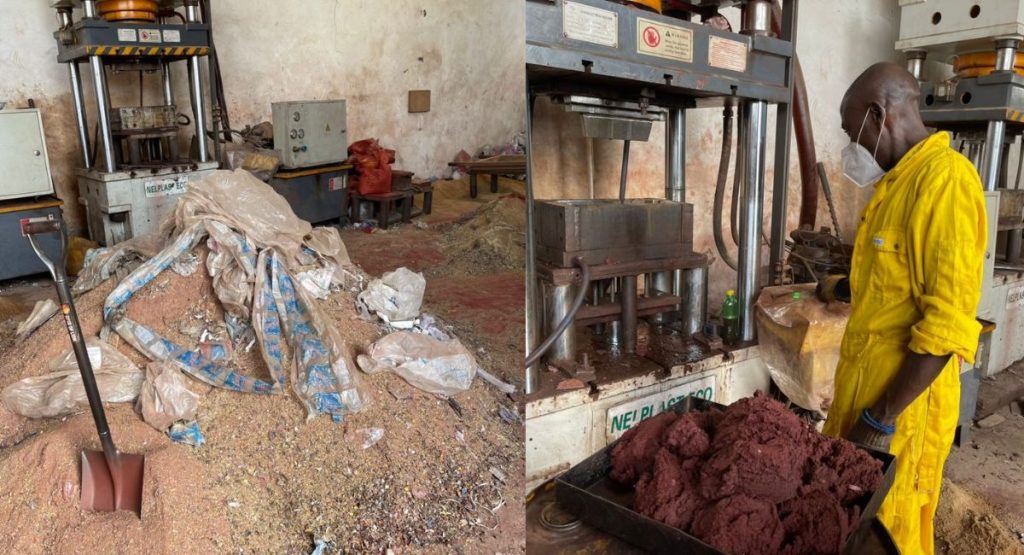
To uncover ground realities and real-world difficulties, the author conducted an interview with Nelpast CEO and founder Nelplast Boateng. Nelplast Eco Ghana Ltd is an environmental and construction company that converts plastic waste into eco-friendly building materials, such as eco-bricks, pavement blocks and plastic pellets. In 2019, the company also won SEED Awards for its impactful contributions.
Talking about the challenges, the founder said, “I am facing a lot of challenges in terms of scaling this business. People like the idea of a waste economy but when it comes to investing in my country, it becomes challenging. We also face difficulty in accessing grants and funding from the government to expand.” However, the UN and UNIDO have been really helpful in expanding our new factory for plastic recycling. He also talked about a shift in people’s mindset who are starting to see waste as a viable resource that can generate income and add value to economy.
Boateng also explained how his company is contributing to formalization of informal sector, “We bring the waste pickers to field and teach them how to build plastic bricks. We have the women who operate the machines. So, it is not just about waste collection, it is about creating knowledge economy.”
Scaling the waste economy: Key recommendations
❖ To address the finance-related issues, the government must mobilize microfinance institutions, government-guaranteed loans and rural banks to provide affordable credit to small waste enterprises.
❖ Implement public-private partnerships and policy reforms to reduce investors risks. Private firms should also adopt cost-recovery strategies to ensure long-term sustainability and service delivery.
❖ Ensure broad stakeholder involvement to ensure effective implementation of policies. Civil society organizations, non-governmental organizations and community-based organizations should actively participate to develop waste management policies.
❖ The equal focus must be placed on enforcing the waste-related laws and regulatory frameworks in advancing the goals of the circular economy.
❖ Most of the waste pickers in Africa belong to the informal sector. To scale up the waste economy, steps should be taken to formalize the waste sector and promote behavioral change among citizens.
❖ Public awareness campaigns and company-based initiatives must be arranged to educate citizens about the benefits offered by the waste economy. The local government should include the concepts of circular economy, sustainable development, and responsible waste disposal practices in school curricula.
❖ Develop a national waste information system to provide reliable data related to waste generation, collection, composition, recycling rates and other important indicators. The data can be used to assess consistency and comparability across various areas and
regions. Eventually, the data can be helpful in policy development.
❖ Invest in research that promotes the development of locally adaptable waste management technologies, including recycling, composting, and anaerobic digestion.
Suggestions by Nelplast
❖ According to CEO and Founder of Nelplast, Nelson Boateng, these recommendations should be implemented to unlock opportunities related to waste and make a huge impact on communities:
● Encourage alternatives to sachet water and plastic bags such as reusable bottles and plastic bags
● School and offices must ban single-use plastics internally
● Promote bulk purchasing instead of individually packaged items
● Stricter laws should be made on waste segregation and disposal
Conclusion
The study explains the economic and sustainable value of waste in Ghana. The evidence revealed that the diverse composition of waste provides opportunities for recycling, composting, waste-to-energy conversion, and housing materials. The production of green
products and initiatives will not only cut back additional costs but also inject value into the national economy. The success of various social enterprises involved in the waste economy also justify the true potential of solid waste management. The companies like Coliba, Nelplast, and Safisana are making an impact in terms of waste management, economic value, job creation, and sustainable development. But these social enterprises also face challenges related to finance, investment, logistics, and favorable policies. To unlock Ghana’s waste-to-resource potential, the study recommends suggestions, highlighting how the gap between formal and informal sectors can be bridged and how the circular economy can be fully implemented.
Work cited
Ahenkan, Albert, et al. “Waste as an economic resource: unlocking the opportunities for sustainable development in Ghana.” Journal of Material Cycles and Waste Management, 2026.
AMPOMAH-BENEFO, KOFI. “Transforming Waste Management in Ghana: Innovations, Benefits, and Policy Reforms for a Circular Economy.” Ghana Climate Innovation Centre (GCIC), 2025, https://ghanacic.ashesi.edu.gh/wp-content/uploads/2025/08/Waste-Management-Policy-Paper.pdf
Beyond Waste Initiative. Green Growth Africa, https://greengrowthafrica.org/beyond-waste-initiative/
Decentralising our waste management can coexist with participation of big private sector industry players. Ghana News, February 2026, https://www.newsghana.com.gh/deceentralising-our-waste-management-can-coexist-with-participation-of-big-private-sector-industry-players-isser
Ghana tackles urban waste management. UNDP, October 2022, https://www.undp.org/blog/ghana-tackles-urban-waste-management
Global Waste Management Outlook 2024. UNEP, 28 February 2024, https://www.unep.org/resources/global-waste-management-outlook-2024
Kusi-Appiah et al. “An Analysis of Municipal Solid Waste Management in Ghana: A Scoping Review of Challenges, Opportunities, and Technology Options.” Sustainability, vol 12, no 18, 2025, pp. 1-26.
Malo, Ifeoma. Nwamadu, Gift. Green technology and youth employment in Africa: A transformative opportunity. Africa Policy Research Institute, 11 November 2024, https://afripoli.org/green-technology-and-youth-employment-in-africa-a-transformative-opportunity
Medium-Term National Development Policy Framework (2026-2029). National Development Planning Commission, October 2025. https://www.ndpc.gov.gh/media/Medium-Term_National_Development_Policy_Framework_Policy_Framework_2026-2029.pdf
Nelson Boateng, Founder of Nelplast .Personal Interview. 25 April, 2026
What a Waste 2.0: A Global Snapshot of Solid Waste Management to 2050. World Bank, 20 September 2018 https://openknowledge.worldbank.org/entities/publication/d3f9d45e-115f-559b-b14f-28552410e90a
Author
Aqsa Qaddus Tahir is a UN volunteer, digital journalist at The News International, and a researcher focusing on sustainability, the environment, and the green economy. Her work explores how sustainability intersects with policy, technology, and everyday life, translating complex global challenges into accessible, impactful stories. She is particularly interested in climate resilience, circular economy models, and the role of innovation in driving sustainable development.